Pagination Patterns for Modern APIs
Compare offset, cursor, keyset, page tokens, and Relay GraphQL pagination with TypeScript and SQL examples for modern APIs.

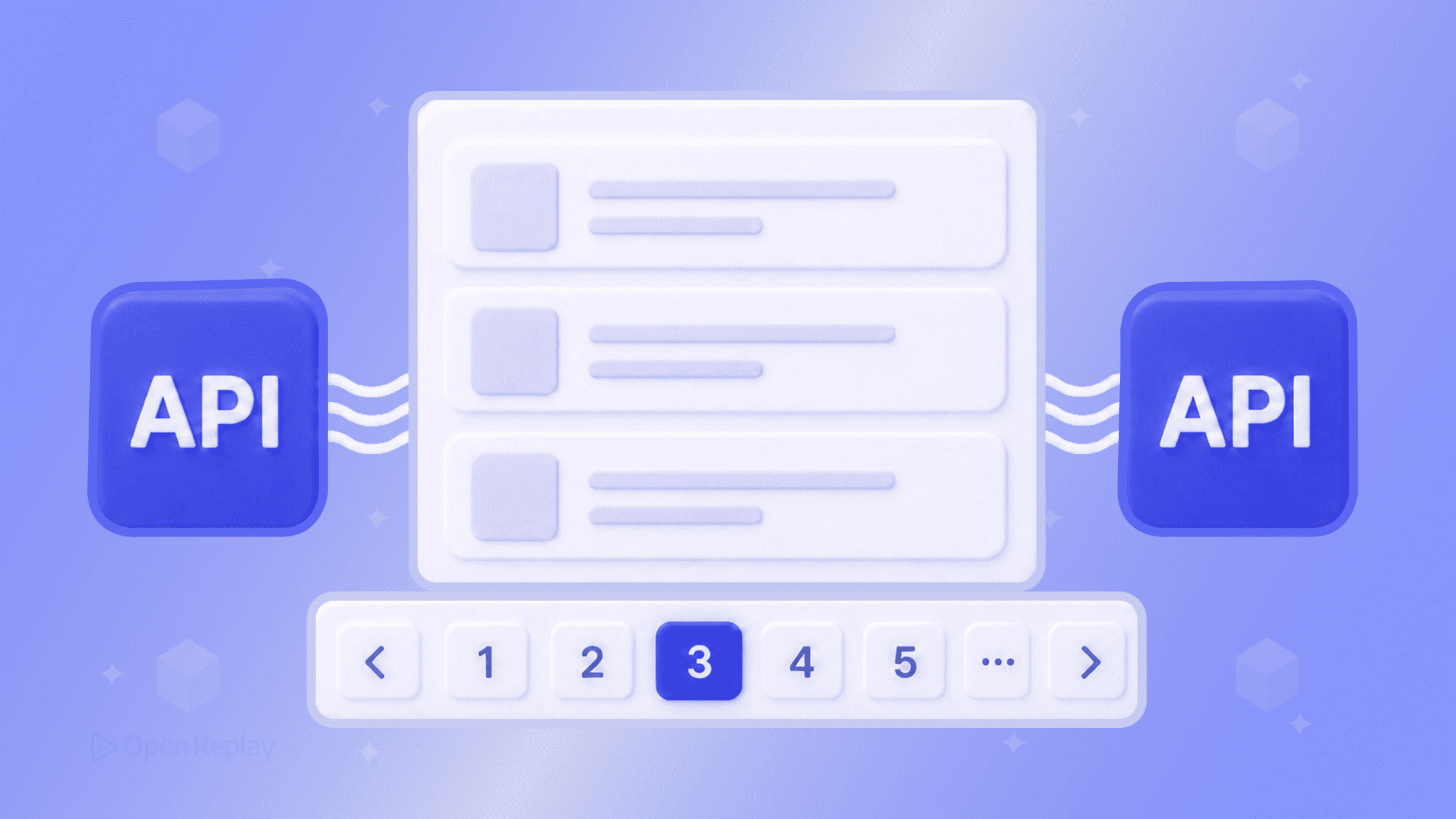
For new list endpoints, default to cursor pagination backed by a keyset query — it delivers near-constant query time regardless of dataset size and stays stable when rows are inserted or deleted between page fetches. Use offset pagination only when users need to jump to an arbitrary page number, the dataset is small and infrequently updated, or a total page count is a hard UI requirement. The decision turns on two failure modes that offset pagination cannot escape: linear slowdown at deep offsets and a shifting-window bug that duplicates or skips items when data changes mid-traversal. This article maps every pattern in the family — offset, cursor, keyset, page tokens, and Relay-style GraphQL connections — with runnable TypeScript and the SQL that backs each one.
Key Takeaways
- Cursor and keyset are not synonyms: a cursor is the opaque token your API returns to the client; keyset is the SQL technique — a compound
WHERE (sort_col, id) < (val, id)predicate — that makes cursor pagination fast by letting the database seek into an index instead of scanning and discarding rows. - A query with
OFFSET 500000 LIMIT 20does not skip 500,000 rows; PostgreSQL reads and discards them before returning 20, so query time grows with the offset value regardless of indexes on the sort column. - When rows are inserted between page fetches, offset pagination shifts the window: the client receives a duplicate item and silently skips another, with no error in the response.
- Returning
total_counton every response forces a separateCOUNT(*); preferhas_next_page, derived cheaply by fetchinglimit + 1rows and checking whether the extra row exists. - A cursor encodes a position in a specific ordered, filtered result set, so it must be discarded and reset to the first page whenever sort or filter parameters change.
Why Pagination Strategy Matters: Two Failure Modes
Pagination strategy matters because the naive default — LIMIT and OFFSET — has two structural failure modes that only surface at scale or under concurrent writes. The first is performance: deep offsets force the database to read and discard rows. The second is consistency: offsets are positional, so any insert or delete between page fetches shifts the window and corrupts the result set. Neither bug appears in a small, static table, which is why offset pagination feels fine in development and breaks in production.
Here is the comparison the rest of the article justifies:
| Pattern | Random page access | Stable under writes | DB performance at depth | Total count | Best for |
|---|---|---|---|---|---|
| Offset / limit | Yes | No | Degrades linearly | Cheap-ish (extra query) | Small static data, admin tables, search UIs needing page numbers |
| Cursor (API surface) | No | Yes | Constant with keyset | Omit; use has_more | Infinite scroll, feeds, public list APIs |
| Keyset (DB technique) | No | Yes | Constant (index seek) | Hard | The implementation under a cursor API |
| Page token | No | Yes | Implementation-defined | Optional | APIs that want to hide and evolve their strategy |
| Relay connection | No | Yes | Constant with keyset | Optional | GraphQL clients using the connections spec |
The two right-hand mechanics — performance and stability — are what separate the patterns. Everything below explains why.
Offset Pagination: How the Shifting Window Breaks
Discover how at OpenReplay.com.
Offset pagination uses page and limit (or offset and limit) to compute a numeric position: offset = (page - 1) * limit. It is the only pattern that supports jumping to an arbitrary page number, which makes it the right choice for admin tables and search results where users click “page 7” directly. Its weaknesses are both consequences of that positional addressing.
The performance weakness is documented behavior, not an implementation quirk. Per the PostgreSQL documentation on LIMIT and OFFSET, “the rows skipped by an OFFSET clause still have to be computed inside the server.” A query with OFFSET 500000 LIMIT 20 does not skip 500,000 rows — the database reads and discards them before returning 20, which means query time grows with the offset value regardless of indexes on the sort column. This semantics is unchanged across recent PostgreSQL majors (16 through 18).
The consistency weakness is the shifting-window bug. When rows are inserted at the top of a feed between page fetches, offset pagination shifts the window: the item at position offset on page N+1 is the item that was at position offset - 1 on page N, so the client receives a duplicate — and the item that fell off the boundary is silently skipped, with no error in the response. A deletion produces the mirror image: the window contracts and an item is skipped.
Here is a correct offset endpoint in TypeScript with Express and pg 8.22.x, running on Node 24 (Active LTS):
// Node 24 (Active LTS), pg 8.22.x, PostgreSQL 18
import express from "express";
import { Pool } from "pg";

const pool = new Pool();
const app = express();

interface OffsetPage<T> {
  data: T[];
  pagination: {
    page: number;
    limit: number;
    has_next_page: boolean;
  };
}

function clampLimit(raw: unknown): number {
  const n = Number(raw) || 20;
  return Math.min(Math.max(Math.trunc(n), 1), 100); // clamp 1–100
}

app.get("/posts", async (req, res) => {
  const limit = clampLimit(req.query.limit);
  const page = Math.max(Number(req.query.page) || 1, 1);
  const offset = (page - 1) * limit;

  // Fetch limit + 1 to learn has_next_page without a COUNT query
  const { rows } = await pool.query(
    `SELECT id, title, created_at
       FROM posts
       ORDER BY created_at DESC, id DESC
       LIMIT $1 OFFSET $2`,
    [limit + 1, offset]
  );

  const has_next_page = rows.length > limit;
  const data = rows.slice(0, limit);

  const body: OffsetPage<typeof data[number]> = {
    data,
    pagination: { page, limit, has_next_page },
  };
  res.json(body);
});
Two details carry their weight here. The clampLimit function caps page size at 100 so a client cannot request limit=1000000 and exhaust the server. And fetching limit + 1 rows lets the endpoint report has_next_page without a second COUNT(*) query — the same trick the cursor implementation uses below. If the extra row exists, there is at least one more page.
Cursor Pagination: The API Surface
Cursor pagination replaces the numeric offset with an opaque token that marks a fixed position in the result set. The client sends the token back to fetch the next page, and because the token anchors to a row’s actual sort values rather than a count, inserts and deletes elsewhere in the table do not corrupt the window. The trade-off is the loss of random page access: there is no “page 7,” only “the page after this cursor.”
Cursor and keyset are not synonyms, and conflating them is the most common error in pagination writeups. A cursor is the opaque token your API returns to the client, hiding the pagination strategy; keyset is the SQL technique — a compound WHERE (sort_col, id) < (val, id) predicate — that makes cursor pagination fast by letting the database use an index seek instead of scanning and discarding rows. You can implement a cursor API with an offset query underneath (don’t — it inherits the deep-offset slowdown) or with a keyset query underneath (do). The cursor is the interface; keyset is the efficient engine.
The token itself is just an encoded position — typically the sort column and a tiebreaker, base64-encoded so clients treat it as opaque and don’t depend on its internal shape. Keep it opaque so you can change what’s inside it later without breaking clients mid-traversal.
// Node 24 (Active LTS), pg 8.22.x, PostgreSQL 18
interface CursorPage<T> {
  data: T[];
  pagination: {
    next_cursor: string | null;
    has_more: boolean;
  };
}

type Cursor = { created_at: string; id: number };

function encodeCursor(c: Cursor): string {
  return Buffer.from(JSON.stringify(c)).toString("base64url");
}

function decodeCursor(raw: string): Cursor {
  return JSON.parse(Buffer.from(raw, "base64url").toString("utf8"));
}

app.get("/feed", async (req, res) => {
  const limit = clampLimit(req.query.limit);
  const cursor = req.query.cursor
    ? decodeCursor(String(req.query.cursor))
    : null;

  // Keyset predicate: compound row comparison on the sort tuple
  const { rows } = cursor
    ? await pool.query(
        `SELECT id, title, created_at
           FROM posts
          WHERE (created_at, id) < ($1, $2)
          ORDER BY created_at DESC, id DESC
          LIMIT $3`,
        [cursor.created_at, cursor.id, limit + 1]
      )
    : await pool.query(
        `SELECT id, title, created_at
           FROM posts
          ORDER BY created_at DESC, id DESC
          LIMIT $1`,
        [limit + 1]
      );

  const has_more = rows.length > limit;
  const data = rows.slice(0, limit);
  const last = data[data.length - 1];

  const body: CursorPage<typeof data[number]> = {
    data,
    pagination: {
      has_more,
      next_cursor:
        has_more && last
          ? encodeCursor({ created_at: last.created_at, id: last.id })
          : null,
    },
  };
  res.json(body);
});
The endpoint decodes the cursor into a (created_at, id) tuple, runs a keyset query against it, fetches limit + 1 to compute has_more, and encodes the next cursor from the last returned row. No COUNT(*), no offset, no scan of discarded rows.
Keyset Pagination: The Compound Predicate
Keyset pagination is the database technique that makes cursor pagination fast: instead of an offset, it filters on the sort key itself with a compound predicate. PostgreSQL supports row value comparisons, so (created_at, id) < ($1, $2) compares the tuple lexicographically and lets a matching composite index seek directly to the boundary.
The tiebreaker is not optional. created_at alone is not unique — two posts can share a timestamp to the millisecond — and a sort on a non-unique column produces a nondeterministic order, which means a cursor anchored to created_at could skip or repeat rows that share that value. Appending the primary key (id) makes the sort tuple unique and the boundary deterministic.
-- PostgreSQL 18
-- Composite index matching the sort tuple, including its direction.
CREATE INDEX idx_posts_cursor ON posts (created_at DESC, id DESC);

-- Keyset query: compound predicate seeks into the index.
SELECT id, title, created_at
FROM posts
WHERE (created_at, id) < ($1, $2)
ORDER BY created_at DESC, id DESC
LIMIT $3;
The index direction matters. Per the PostgreSQL documentation on indexes and ORDER BY, a B-tree index can be scanned in either direction, but matching the index’s declared order to the query’s ORDER BY lets the planner satisfy both the predicate and the sort from a single index scan. Run EXPLAIN ANALYZE on both forms against a large table and the structural difference is visible in the plan: the OFFSET 500000 query shows the server computing and discarding the leading rows, while the keyset query shows an index scan with a low startup cost that returns only the rows it needs. The cost difference is structural, not incidental — it follows directly from the documented OFFSET semantics above.
Page Tokens: Hiding the Strategy
Page tokens are the opaque-strategy variant of cursor pagination, used most cleanly by Google Cloud’s API design guidelines. Under AIP-158, the request carries page_size and page_token, the response returns a next_page_token, and the spec requires that page tokens be opaque to the client. Encoding the full pagination state server-side lets the server change its internal strategy — from offset to keyset, for example — without breaking clients that are mid-traversal.
Stripe is frequently cited alongside Google here, but the two are not the same mechanism, and the distinction is worth getting right. Per the Stripe pagination docs, Stripe’s list API uses object-ID cursors (starting_after and ending_before, with limit and a has_more flag), not opaque page tokens; its search API is the one that returns an opaque next_page token. So the precise survey reads: Google Cloud uses opaque page tokens, Stripe’s list endpoints use object-ID cursors, Shopify uses cursor-based connections via its GraphQL Admin API, and GitHub’s REST API paginates via the Link header — page-number-based on most endpoints, with cursor-based (before/after) only on specific ones. The common thread is cursor-style traversal, not a single uniform mechanism.
Relay-Style GraphQL Connections
Relay connections are the GraphQL specialization of cursor pagination, formalized so that every list field in a schema paginates the same way. The Relay Cursor Connections Specification defines a connection as a list of edges, where each edge has a node (the item) and a cursor (its opaque position), plus a pageInfo object exposing hasNextPage, hasPreviousPage, startCursor, and endCursor.
query {
  posts(first: 10, after: "cursor123") {
    edges {
      cursor
      node { id title }
    }
    pageInfo {
      hasNextPage
      endCursor
    }
  }
}
The per-edge cursor is the same opaque token concept from the REST sections, and pageInfo.hasNextPage is the same has_more flag derived from the fetch-one-extra trick. The structure is heavier than a plain { data, pagination } envelope, but it gives clients a uniform contract: paginate any connection by passing first/after and reading pageInfo. Under the hood, a Relay connection should still be backed by a keyset query for the same performance reasons.
Choosing a Pattern and Avoiding the Common Traps
Default to cursor pagination backed by keyset for any new list endpoint, and reach for offset only when a specific requirement forces it. The decision matrix:
| Use case | Pattern |
|---|---|
| Infinite-scroll feed, activity stream, notifications | Cursor + keyset |
| Public list API you may want to re-implement later | Page token (opaque) |
| GraphQL list field | Relay connection (keyset underneath) |
| Bulk export of a large table | Cursor + keyset |
| Admin table with “jump to page N” | Offset |
| Search UI that shows page numbers | Offset |
| Small (<10k rows), rarely-changing reference data | Offset (either is fine) |
A handful of practices keep all of these correct in production:
- Cap page size. Clamp
limitto a fixed maximum (100 is a common ceiling) so a client cannot request an unbounded page. - Index the full sort tuple. The composite index must match both columns and directions of the
ORDER BY, or the keyset query falls back to a scan. - Prefer
has_next_pageover total counts. Returningtotal_counton every response forces a separateCOUNT(*), whose cost on a large table depends on table bloat and the visibility map; derivehas_next_pagecheaply from thelimit + 1row instead and reserve total counts for UIs that genuinely require them. - Keep cursors opaque. Encode them so clients can’t depend on the internal format, leaving you free to change the underlying strategy.
- Reset the cursor on filter or sort change. A cursor encodes a position in a specific ordered, filtered result set; when the user changes a sort order or applies a new filter, that cursor is invalid for the new query and must be discarded — reset to the first page whenever sort or filter parameters change. In a client, that means tying the cursor state to the filter state so a filter change clears the accumulated pages and refetches.
The shifting-window and deep-offset bugs are easy to miss in testing because they only appear under concurrent writes or at depth, and several of them never reach your error logs. The shifting-window bug is invisible in server logs — the response is a valid 200 with the correct number of items — but in session replay we see it as a specific rendering artifact: an item that was already visible in the viewport renders again in the next batch, immediately adjacent to its previous position. Deep-offset slowdown shows up the same way: not as a timeout or a 4xx, but as a “load more” spinner that never resolves on a slow 200 the client is still waiting for. Because these are interaction-sequence symptoms rather than discrete errors, session replay is often how we surface them — they live in the full sequence of scroll, fetch, and render, not in a single failed request.
Conclusion
Reach for cursor pagination backed by a keyset query on the next list endpoint you build, and treat offset as the exception you justify rather than the default you inherit — its linear deep-offset cost and shifting-window instability are structural, not tunable. Add the composite index on your sort tuple, return has_next_page instead of a total count, and keep the cursor opaque so you can swap the engine underneath without a breaking change.
FAQs
Can I add cursor pagination to an existing offset-based API without breaking clients?
Yes, but treat it as a new parameter rather than a swap. Accept a cursor query parameter alongside the existing page and limit parameters, and route requests that carry a cursor to the keyset query while leaving page-based requests on the offset path. Keep the cursor opaque so the internal format stays free to change, and document the offset path as deprecated for large or write-heavy endpoints rather than removing it immediately.
What happens to a cursor when the row it points to is deleted?
Nothing breaks, because a keyset cursor encodes sort values rather than a row reference. The compound predicate (created_at, id) < (val, id) selects every row ordered after that boundary tuple, so the next page returns correctly even if the exact anchor row no longer exists. This is the core advantage over offset pagination, where a deletion shifts every subsequent position and causes the client to silently skip an item.
Why use base64-encoded JSON for a cursor instead of just sending the timestamp and ID directly?
Encoding makes the cursor opaque, which signals to clients that the token is not meant to be parsed or constructed by hand. If clients read the raw timestamp and ID, they couple themselves to your internal pagination strategy and break when you change it. An opaque base64 token lets you add fields, switch sort keys, or move from keyset to page tokens without a client-side change. The encoding adds no meaningful overhead.
Does cursor pagination work when sorting by a column other than created_at, like a popularity score?
Yes, provided the cursor encodes the same sort tuple the query orders by and ends with a unique tiebreaker. Sorting by a popularity score requires the predicate and index to cover (score, id) and the cursor to carry both values, since scores collide far more often than timestamps. Without the unique id tiebreaker, rows sharing a score produce a nondeterministic order that can skip or repeat items across pages.