Browser Tab Synchronization with BroadcastChannel
BroadcastChannel syncs tabs in real time with structured-clone messages, cleanup, fallback support, and practical patterns for auth, cart, and theme state.

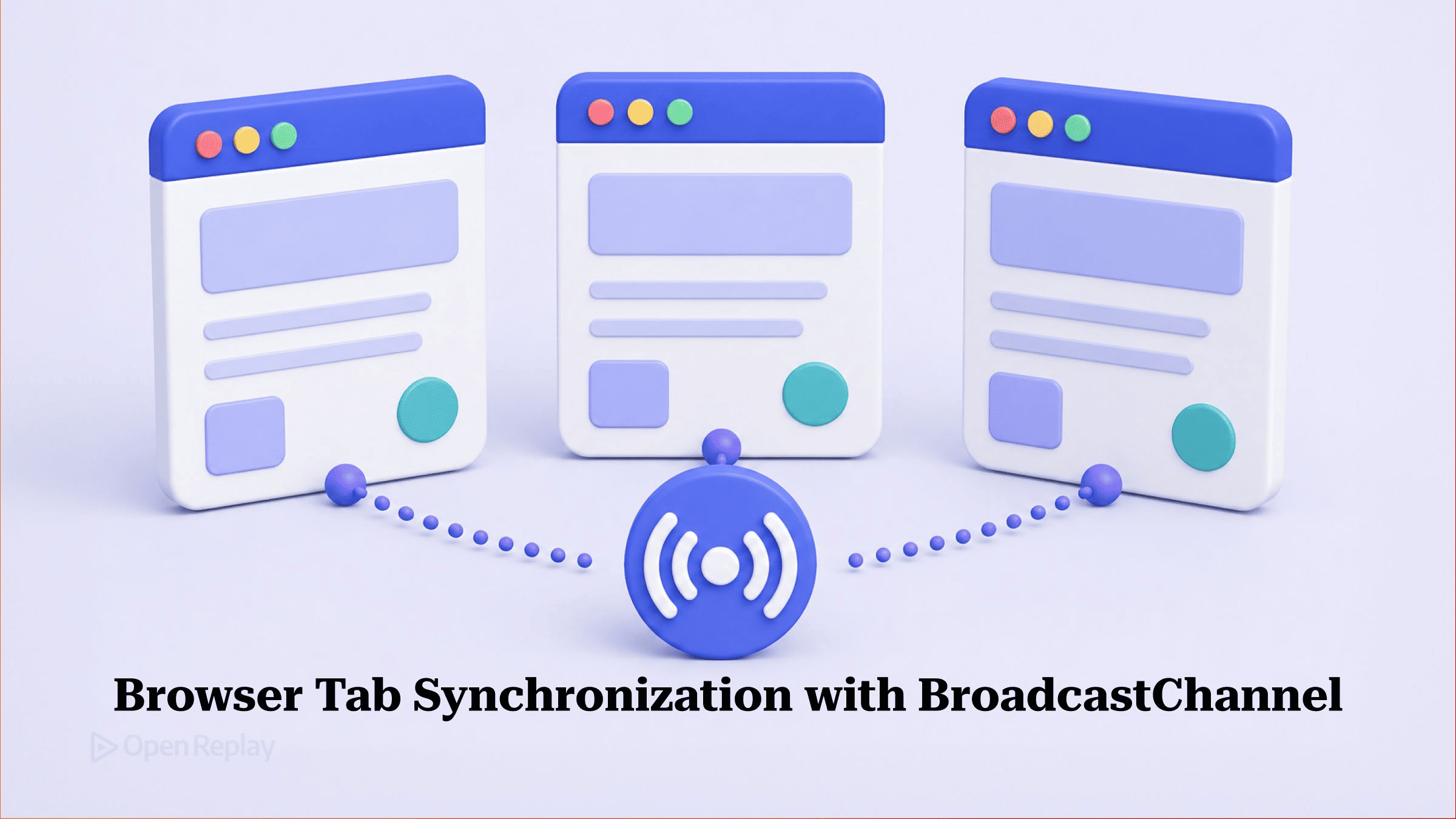
The BroadcastChannel API is a native browser message bus that lets tabs, windows, iframes, and workers on the same origin talk to each other in real time — the purpose-built fix for multi-tab state drift, where a logout in one tab leaves the others still showing a logged-in UI. It’s a four-call API with no server, no handshake, and no dependencies. This article covers the minimal API, the action-typed message pattern that scales, framework integration with correct cleanup, the non-obvious gotchas, and current browser support with a runnable fallback.
Key Takeaways
- The entire API is four calls —
new BroadcastChannel(name),postMessage(data),onmessage, andclose()— with no server, handshake, or configuration. - Because
postMessageuses the structured clone algorithm, you send objects, Maps, Sets, and Blobs directly — noJSON.stringify, no manual parsing on the other side. - A tab never receives its own broadcasts: messages fire on every listening channel except the object that sent them, which stops the feedback loops you’d otherwise hand-guard against.
- BroadcastChannel is a pipe, not a bucket — it transports messages but stores nothing, so pair it with localStorage or IndexedDB for durability and to hydrate tabs opened after an event fired.
- BroadcastChannel is Baseline, widely available across Chrome, Firefox, Edge, Safari, Opera, and Samsung Internet since March 2022, with Safari support landing in 15.4; only Internet Explorer lacks it.
What is multi-tab state drift?
Multi-tab state drift is the class of bug where two open tabs of the same app hold divergent state: you log out in one and the other still renders the dashboard, or you empty a cart in one and the other still shows items. Session replays of these flows regularly surface the visible symptom — a user submitting against a cart emptied elsewhere, or continuing in a tab that should have logged out — which is exactly the desync BroadcastChannel eliminates.
Developers have patched this with three inferior workarounds. The localStorage storage event fires across tabs but carries strings only, forcing serialize/parse on every message and awkward key juggling. Polling a server or localStorage on an interval is wasteful and laggy — you pay for checks that mostly find nothing. SharedWorker and WebSockets are real tools, but a socket round-trip through a server to sync two tabs on the same machine is heavy for a purely local problem.
| Mechanism | Payload type | Persists? | Network needed | Best for |
|---|---|---|---|---|
| BroadcastChannel | Structured clone (objects, Maps, Blobs) | No | No | Local same-origin tab/worker sync |
storage event | Strings only | Yes (localStorage) | No | Simple sync with built-in durability |
| SharedWorker | Structured clone | No | No | Shared computation/connection across tabs |
| WebSocket | Strings/binary | Server-side | Yes | Live server-pushed data across clients |
The BroadcastChannel API in four calls
Discover how at OpenReplay.com.
The entire API is four calls, and any context that constructs a channel with the same name joins the same bus. You connect, listen, post, and close:
const channel = new BroadcastChannel("app-sync");

channel.onmessage = (event) => {
  console.log("Received:", event.data);
};

channel.postMessage({ hello: "world" });

channel.close(); // on unmount / teardown
The payload is the key advantage. Data sent through postMessage is serialized with the structured clone algorithm, so you pass objects, arrays, Map, Set, and Blob directly without stringifying — the receiver reads event.data as a live object. Symbols and SharedArrayBuffer are the notable exceptions that won’t clone. Channels are same-origin only, and reusing one channel instance per context matters: constructing a fresh BroadcastChannel on every send leaks listeners.
How should you structure BroadcastChannel messages?
The pattern that scales is a discriminated message — { type, payload } — plus one listener that switches on type and applies each action to local state. This keeps every context speaking the same protocol; the API itself assigns no meaning to messages, so you define one.
const channel = new BroadcastChannel("cart-sync");
let cart = [];

channel.onmessage = ({ data }) => {
  if (data.type === "ADD_ITEM") cart.push(data.payload);
  else if (data.type === "CLEAR") cart = [];
  render();
};

function addItem(item) {
  cart.push(item);       // update this tab immediately
  render();
  channel.postMessage({ type: "ADD_ITEM", payload: item });
}
Note the sender updates its own state directly before broadcasting — because a tab doesn’t hear its own messages, you apply the local change inline and let the broadcast fan out to everyone else.
Syncing auth, cart, and settings across tabs
The highest-value uses are session sync (a logout broadcast clears every tab), cart/settings/theme sync, and multi-tab form autofill. In React, create the channel inside useEffect and return a cleanup that calls close(); skip it and every remount leaks a live listener.
import { useEffect } from "react";

function useAuthSync(onLogout) {
  useEffect(() => {
    const channel = new BroadcastChannel("auth");
    channel.onmessage = ({ data }) => {
      if (data.type === "LOGOUT") onLogout();
    };
    return () => channel.close();
  }, [onLogout]);
}

// on logout: clear local session, then
// new BroadcastChannel("auth").postMessage({ type: "LOGOUT" })
In Svelte 5 (runes), wrap the channel in a store. One caveat: postMessage needs a plain clone, not a reactive proxy, so pass the value through $state.snapshot before broadcasting — a proxy would choke the structured clone step.
// theme.svelte.js — Svelte 5 (runes)
export class ThemeStore {
  value = $state("light");
  #channel = new BroadcastChannel("theme");
  constructor() {
    this.#channel.onmessage = ({ data }) => { this.value = data; };
  }
  set(next) {
    this.value = next;
    this.#channel.postMessage($state.snapshot(next));
  }
}
The gotchas most tutorials skip
Four behaviors trip up implementations, and they’re where most write-ups go quiet:
- A tab cannot hear its own broadcasts. Messages fire at every channel listening except the object that sent the message — this is spec behavior, and it’s helpful: it prevents the infinite feedback loops you’d otherwise guard against with a self-ID check. Apply the sender’s own change inline.
- “Same-origin” is really “same storage partition.” Storage partitions by top-level site, so a cross-site iframe won’t share a channel with a top-level page even at the same origin, and channels never bridge different subdomains.
- It’s a pipe, not a bucket. BroadcastChannel transports messages but stores nothing. Pair it with localStorage or IndexedDB both for durability and to hydrate tabs that open after an event fired — a late tab that never heard the broadcast reads persisted state on mount.
- Always
close()on unmount. Closing disconnects the object and frees it for garbage collection; a channel created per component and never closed leaks a listener on every remount.
Browser support and a feature-detected fallback
BroadcastChannel is Baseline and widely available since March 2022, and current Safari fully supports it — the “doesn’t work in WebKit” claim predates Safari 15.4. Per caniuse and the Chrome for Developers blog, the floors are Chrome 54+, Edge 79+, Firefox 38+, Safari 15.4+ (macOS and iOS), Opera 41+, and Samsung Internet 7.2+; only Internet Explorer never shipped it.
For pre-2022 browsers, feature-detect with 'BroadcastChannel' in window and fall back to a storage-event shim exposing the same interface:
function createChannel(name) {
  if ("BroadcastChannel" in window) return new BroadcastChannel(name);
  // Fallback: localStorage "storage" event (strings only)
  return {
    postMessage: (data) =>
      localStorage.setItem(name, JSON.stringify({ data, t: Date.now() })),
    set onmessage(fn) {
      window.addEventListener("storage", (e) => {
        if (e.key === name && e.newValue) fn({ data: JSON.parse(e.newValue).data });
      });
    },
    close() {},
  };
}
Reach for the native API first and treat the shim as insurance. On every current browser, BroadcastChannel is already there — pick one channel name, standardize on { type, payload }, persist what must survive a full close, and the stale-tab bug hiding in your app disappears.
FAQs
Does BroadcastChannel work across different subdomains?
No. BroadcastChannel is scoped to the same storage partition, not just the same origin, and it never bridges different subdomains. A page on app.example.com and a page on account.example.com cannot share a channel. Even at the same origin, a cross-site iframe will not share a channel with the top-level page because storage partitions by top-level site. For cross-subdomain sync, use a server or a WebSocket.
What is the difference between BroadcastChannel and the storage event for cross-tab sync?
BroadcastChannel transports structured-clone payloads such as objects, Maps, Sets, and Blobs directly, but stores nothing. The localStorage storage event carries strings only, forcing you to serialize and parse every message, but it writes durable state as a side effect. Use BroadcastChannel for rich, message-driven sync and pair it with localStorage or IndexedDB when you also need persistence or need to hydrate tabs opened after an event fired.
Does the tab that sends a BroadcastChannel message receive its own message?
No. Per spec, a message fires at every BroadcastChannel object listening to the channel except the object that sent it. A tab never hears its own broadcasts, which prevents the infinite feedback loops you would otherwise guard against with a self-ID check. Because of this, apply the sender's own state change inline before calling postMessage, then let the broadcast fan out to every other context.
What happens to BroadcastChannel messages if all tabs are closed?
They are lost. BroadcastChannel is a pipe, not a bucket: it transports messages but stores nothing, so any state broadcast while no other tab was listening is gone once all instances close. A tab opened after an event fired never hears the original message. To survive this, persist state to localStorage or IndexedDB and hydrate late-opening tabs from that storage on mount rather than relying on the channel alone.