What Is Chrome DevTools MCP?

AI coding assistants are remarkably good at writing code. What they can’t do—at least not until recently—is see what that code actually does when it runs in a browser. They suggest fixes based on static analysis, with no visibility into console errors, network failures, or layout problems happening at runtime. Chrome DevTools MCP changes that.
Key Takeaways
- Chrome DevTools MCP is an official MCP server that connects AI coding assistants to a live Chrome browser, giving them access to runtime data like console errors, network requests, and DOM state.
- MCP (Model Context Protocol) is an open protocol originally introduced by Anthropic that defines how AI models communicate with external tools—Chrome DevTools MCP is Google’s implementation of it.
- AI agents can now inspect the DOM, analyze network traffic, capture screenshots, run performance traces, and simulate user interactions programmatically.
- The server runs locally as a Node.js process, uses Puppeteer and the Chrome DevTools Protocol under the hood, and works with clients like Cursor, Claude Code, Gemini CLI, Cline, and Windsurf.
The Problem: AI Agents Are Debugging Blind
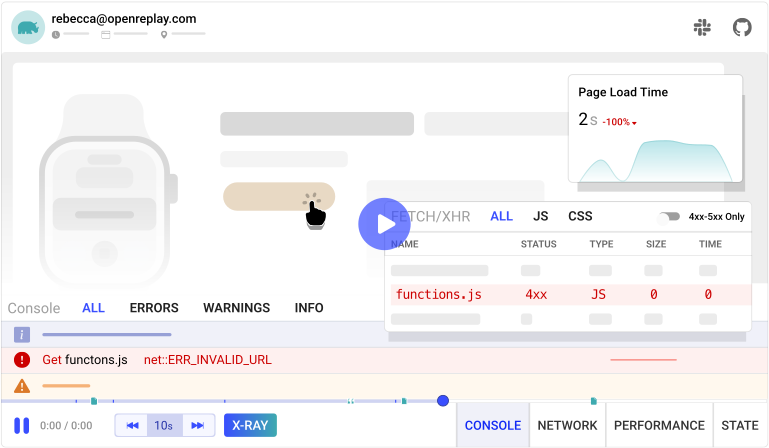
When you ask an AI assistant to fix a bug, it works from the source code alone. It can’t inspect a live DOM, read a console error, or check whether a network request returned a 404. The result is educated guessing rather than actual diagnosis. For anything beyond simple logic errors, that limitation matters.
What Is Chrome DevTools MCP?
Chrome DevTools MCP is an official MCP server from the Chrome DevTools team that connects AI coding assistants to a real, running Chrome browser. MCP stands for Model Context Protocol, an open protocol introduced by Anthropic that defines how large language models communicate with external tools and data sources. Think of it as a universal adapter: instead of building custom integrations for every tool, developers expose functionality through a standard MCP server, and any compatible AI client can use it.
The Chrome DevTools MCP server is Google’s contribution to this ecosystem. It exposes Chrome’s debugging surface—the same capabilities you use manually in DevTools—so that AI agents can access them programmatically during a development session.
Compatible AI clients include Cursor, Claude Code, Gemini CLI, Cline, and Windsurf.
What Can AI Agents Actually Do With It?
Once connected through the Chrome DevTools MCP server, an AI agent gains access to a broad set of browser capabilities:
- Console log inspection — read runtime errors and warnings directly from the page
- Network request analysis — identify failed requests, CORS errors, slow API calls, or missing resources
- DOM inspection and scripting — examine the live DOM structure and page state
- User interaction simulation — navigate pages, fill forms, click buttons, and handle dialogs
- Screenshots and snapshots — capture the rendered page visually or as a DOM snapshot
- Performance tracing — run a trace equivalent to Chrome’s Performance panel, then analyze metrics like Largest Contentful Paint (LCP)
- Environment emulation — simulate slow network conditions, CPU throttling, or different viewport sizes
This is browser debugging powered by DevTools capabilities, not static code review. The agent can navigate to localhost:8080, spot that three images are returning 404s, trace the issue to a misconfigured asset path or missing CORS header, and suggest a fix—all based on what it actually observed in the browser.
Discover how at OpenReplay.com.
How It Works at a High Level
The Chrome DevTools MCP server runs as a Node.js process on your local machine. It uses Puppeteer to control Chrome, which in turn communicates with the browser through the Chrome DevTools Protocol (CDP). The MCP layer wraps all of this behind named tools—like navigate_page, list_console_messages, or performance_start_trace—that an AI client can call without knowing anything about Puppeteer or CDP directly.
The server can launch its own isolated Chrome session or connect to an existing Chrome instance via remote debugging. It is not a browser extension and does not replace DevTools. It is a bridge that makes DevTools capabilities available to AI assistants programmatically.
What This Means for Your Workflow
The practical shift is significant. Instead of pasting error messages into a chat window and describing what you see, you can tell your AI agent to look for itself. It collects real data, forms a diagnosis based on evidence, and proposes targeted fixes. Early users report that it handles console errors, 500 responses, and layout issues with minimal prompting—and uses surprisingly little context in the process.
Conclusion
Chrome DevTools MCP bridges the gap between AI code generation and real-world browser behavior. By giving AI agents direct access to runtime data—console logs, network activity, DOM state, and performance metrics—it transforms debugging from guesswork into evidence-based diagnosis. If you want to explore it further, the official GitHub repository has documentation, configuration options, and an issue tracker where you can influence what gets built next.
FAQs
Chrome DevTools MCP works with recent versions of Chrome or Chromium. It relies on the Chrome DevTools Protocol, so you need a version that supports the CDP features the server uses. In most cases, keeping Chrome up to date is sufficient. Check the official repository for any minimum version requirements.
The server primarily targets local development workflows. It can connect to any Chrome instance with remote debugging enabled, but it is designed to run on the same machine as the browser. Connecting to a truly remote browser would require network-level configuration and is not a primary use case.
The MCP server itself runs locally on your machine and communicates with Chrome through the local DevTools Protocol. However, optional features such as usage statistics or integrations with external services may send limited telemetry unless disabled. Additionally, the AI client you connect may process tool outputs through its own model, so review your AI client's data handling policies.
Yes. Chrome DevTools MCP is an open-source project released by the Chrome DevTools team. You can install and use it at no cost. The AI clients you pair it with, such as Cursor or Claude Code, may have their own pricing, but the MCP server itself is free.
Understand every bug
Uncover frustrations, understand bugs and fix slowdowns like never before with OpenReplay — the open-source session replay tool for developers. Self-host it in minutes, and have complete control over your customer data. Check our GitHub repo and join the thousands of developers in our community.