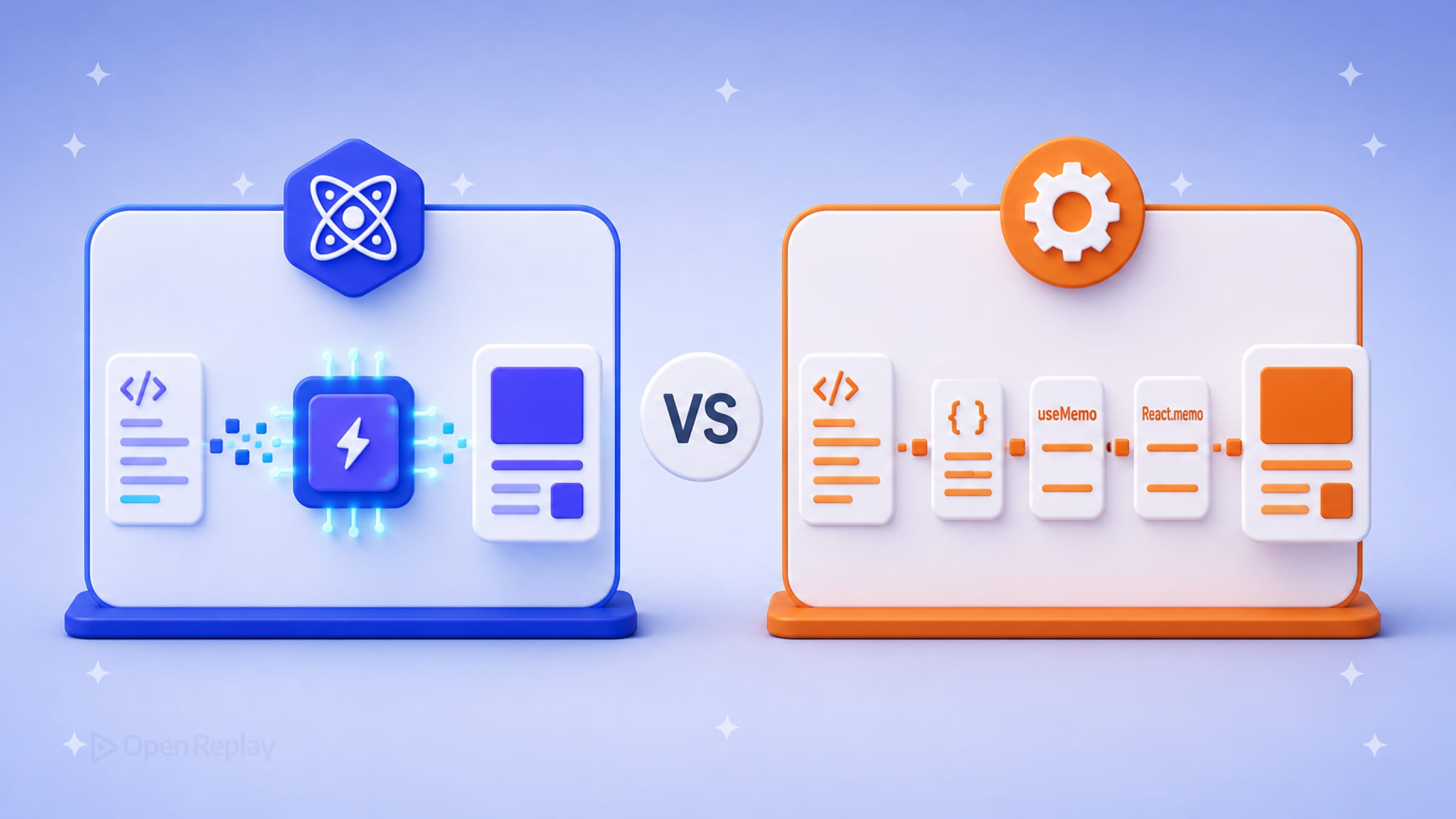
Is OpenTUI a Real Alternative to Ink?
OpenTUI vs Ink: compare terminal UI performance, runtime limits, built-in components, and migration tradeoffs for streaming apps and CLI tools.

OpenTUI is a real alternative to Ink for terminal UIs that redraw continuously, such as streaming agent output, log viewers, and live dashboards, but its bleeding-edge runtime requirements and 0.x release churn make Ink the safer default for a CLI you publish to everyday Node users.
If you have ever watched your own Ink dashboard stutter under a busy log stream, you already know why people are looking around. That gap is what OpenTUI was built to close.
What follows applies the same criteria to both libraries: where Ink’s renderer tops out, what OpenTUI’s architecture changes, what the same small UI looks like in each, what production credit OpenTUI has earned, and what a switch costs in runtime, ecosystem, and stability. It ends with a recommendation.
Key Takeaways
- OpenTUI renders through a native core written in Zig, reached from TypeScript over FFI, with Yoga flexbox layout and both React and Solid bindings.
- Ink throttles redraws to 30 fps by default, configurable through the
maxFpsrender option; the “32 FPS” figure that circulates online is a misreading of the 32 millisecond throttle interval in Ink’s source. - An OpenTUI CLI requires every end user to run Bun 1.3+ or Node.js 26.4+ with the experimental
--experimental-ffiflag, which is a distribution constraint, not just a local setup step. - OpenTUI renders OpenCode’s terminal interface in production through its Solid reconciler, replacing a Go and Bubble Tea implementation.
- OpenTUI’s 0.5.x line ships multiple releases per month, while Ink changes far more slowly: its last breaking release, Ink 7, raised the floor to Node 22 and React 19.2 and left the component API intact. Ink also has a far larger ecosystem of community components.
Where Does Ink’s Renderer Top Out?
Ink’s ceiling is its render throttle: by default it caps redraws at 30 frames per second, and every state update beyond that budget waits for the next frame. For Ink fundamentals, see the earlier guide to building terminal interfaces with Node.js, which recommended Ink in December 2025, before OpenTUI was a serious option; this article is the update to that verdict.
The throttle is documented, not folklore. Ink historically hard-coded a 32 millisecond throttle around its render function, which is where the widely repeated “32 FPS cap” figure comes from: 32 is the interval in milliseconds, and the rate that falls out of it is a ceiling of 30 frames per second. Current Ink exposes this as the maxFps render option, default 30, alongside an incrementalRendering option that limits each repaint to the lines that changed. So the cap is adjustable. What is not adjustable is the architecture: every frame is composed in JavaScript, diffed as strings, and written to stdout by the same event loop running your application logic.
For a spinner, a form, or a progress bar, none of this is observable. It becomes observable when output streams: model tokens arriving faster than the frame budget, a log viewer tailing a busy service, a dashboard re-rendering large regions. There is also a memory floor. An Ink process carries the Node runtime plus React’s reconciler for what might be a few lines of output; no reliable public measurement of that overhead exists, so treat any specific megabyte figure you read with suspicion.
What Does OpenTUI Add?
OpenTUI moves rendering out of JavaScript entirely. Its core is written in Zig and handles the screen buffer, drawing, and input parsing natively; TypeScript reaches it over FFI, bun:ffi on Bun or Node’s experimental FFI. Layout stays familiar: sizing and positioning run through Yoga-based flexbox, the same engine Ink uses, so flexDirection, flexGrow, and friends transfer directly.
Two additions matter beyond the renderer. First, built-in components cover ground Ink leaves to third-party packages: a focusable Input and Textarea, Select, ScrollBox, tree-sitter-backed syntax highlighting in Code, a Diff view, and Markdown. Two more, a text table and an embedded terminal, exist as Core renderables only, so React and Solid cannot reach them as JSX elements. Second, framework choice: @opentui/react and @opentui/solid are both first-class bindings, so teams that prefer fine-grained reactivity for high-frequency updates are not locked into React’s reconciler. There is also a Three.js WebGPU integration, a curiosity for this comparison and Bun-only besides.
What Does the Same UI Look Like in Ink and OpenTUI?
Migration cost is easiest to see by building one UI twice: a bordered panel, a line of text, a key toggling state, and a clean exit. The snippets target Ink 7 and OpenTUI 0.5.x.
Ink, scaffolded with npx create-ink-app:
import React, { useState } from "react";
import { render, Box, Text, useApp, useInput } from "ink";

function App() {
  const [name, setName] = useState("world");
  const { exit } = useApp();

  useInput((input, key) => {
    if (key.escape) exit();
    if (input === "r") {
      setName((prev) => (prev === "world" ? "terminal" : "world"));
    }
  });

  return (
    <Box borderStyle="round" padding={1} flexDirection="column">
      <Text>Hello, {name}! Press r to toggle, Esc to quit.</Text>
    </Box>
  );
}

render(<App />);
OpenTUI, scaffolded with bun create tui --template react:
import { useState } from "react";
import { createCliRenderer } from "@opentui/core";
import { createRoot, useKeyboard, useRenderer } from "@opentui/react";

function App() {
  const [name, setName] = useState("world");
  const renderer = useRenderer();

  useKeyboard((key) => {
    if (key.name === "escape") renderer.destroy();
    if (key.name === "r") {
      setName((prev) => (prev === "world" ? "terminal" : "world"));
    }
  });

  return (
    <box style={{ border: true, padding: 1, flexDirection: "column" }}>
      <text>Hello, {name}! Press r to toggle, Esc to quit.</text>
    </box>
  );
}

const renderer = await createCliRenderer();
createRoot(renderer).render(<App />);
The diff is the migration guide. The entry point changes from Ink’s render() call to createCliRenderer() from @opentui/core plus createRoot(renderer).render() from @opentui/react. Capitalized Box and Text components become lowercase box and text intrinsics, and element names of more than one word take a hyphen, as in <ascii-font>. Ink’s useInput and useApp map to OpenTUI’s useKeyboard and renderer.destroy(). React itself carries over unchanged: both ink and @opentui/react require React 19.2 or later, and useState works identically. Focus models differ more: Ink ships useFocus with built-in Tab cycling, while OpenTUI grants focus through a focused prop you manage in state.
The Credit: OpenTUI Renders OpenCode in Production
OpenTUI is not a demo project. It was built by Anomaly, the company behind OpenCode, and the project’s README claims OpenCode as a production deployment serving millions of people. That workload, a coding agent streaming model output, diffs, and syntax-highlighted code into an interactive terminal, is precisely the workload where Ink’s throttle shows. The lineage matters too: OpenCode’s interface was rewritten from Go and Bubble Tea onto OpenTUI. One caveat for React users: OpenCode’s TUI runs on the Solid reconciler, so production battle-testing covers the core and Solid binding more than @opentui/react, which, unlike Core and Solid, is not covered by a Node.js lane in CI.
The Cost: Churn, Runtimes, and Ecosystem
The costs cluster in three places, and the runtime one is a distribution problem, not a developer-experience problem.
| Criterion | Ink 7 | OpenTUI 0.5.x |
|---|---|---|
| Runtime | Node 22+ | Bun 1.3+ or Node 26.4+ with --experimental-ffi, ESM only |
| Rendering | JavaScript, 30 fps default via maxFps | Native Zig core over FFI |
| Layout | Yoga flexbox | Yoga flexbox |
| Built-ins | Box, Text, Static; inputs via community packages | Input, Select, ScrollBox, Code, Diff, Markdown, more |
| Frameworks | React | React and Solid |
| Maturity | Majors years apart; Ink 7 broke only runtime floors and key events | Multiple releases per month on a 0.x line |
An Ink CLI runs wherever Node 22 or later runs. An OpenTUI CLI puts a bleeding-edge requirement on every end user: per the runtime support matrix, that means Bun 1.3.0+ or Node.js 26.4.0+ with the experimental FFI flag, ESM only, and a CommonJS require fails outright. For a tool published to npm and installed by strangers, that either shrinks your audience or pushes you toward compiled-binary distribution.
Stability is the second cost. The releases page shows v0.4.4 through v0.5.8 landing in roughly six weeks. On a 0.x line that pace means pinned versions and changelog-watching. Ink’s API, by contrast, has held steady across years and majors. Third, ecosystem: Ink’s community packages, recipes, and Stack Overflow answers have no OpenTUI equivalent yet, though OpenTUI’s richer built-ins offset part of that gap. Debugging is roughly at parity; both support React DevTools with DEV=true, and OpenTUI adds a console overlay and rendering diagnostics.
Should You Switch From Ink to OpenTUI?
Switch now if your TUI redraws continuously and you control the runtime: an internal agent frontend, a log viewer for your own team, anything distributed as a compiled binary where the Bun requirement disappears into the build. The Zig core, the Code and Diff components, and the Solid option are genuine advantages there, and OpenCode proves the architecture at scale.
Stay on Ink if you publish a CLI to npm for general Node audiences, if your UI is forms, prompts, and progress rather than continuous streams, or if you cannot absorb breaking changes between minor versions. Ink’s 30 fps default is adjustable via maxFps, and its production roster, Claude Code, Gemini CLI, GitHub Copilot CLI, Wrangler, and Prisma among them, shows how far the throttled model stretches. Bubble Tea and Ratatui remain options for teams willing to leave TypeScript, which defeats the premise here.
Conclusion
OpenTUI earns the “real alternative” label on architecture and production evidence, and Ink keeps the default slot on stability and reach. The deciding question is not which renderer is faster; it is whether your users can run your runtime. Prototype your hottest screen with bun create tui --template react, watch it under a real stream, and let the runtime constraint, not the benchmark, make the call.
FAQs
Is OpenTUI Bun-only or does it also run on Node.js?
No, OpenTUI is not Bun-only. Bun 1.3.0 and up works, and so does Node.js 26.4.0 and up, provided your app is ESM and you start Node with the experimental FFI flag; pull Core in through a CommonJS require and it throws. A few pieces are still Bun-only, among them @opentui/three and plugins loaded at runtime, and Node's FFI support is itself experimental, so Bun remains the better-tested path.
Does OpenTUI work on Windows?
Yes. Prebuilt native core packages ship for Windows x64 and Windows arm64, along with macOS and both glibc and musl builds for Linux. On Windows the project's own testing goes through Bun on x64, while its Node.js acceptance lane sits on Linux x64, so try a Windows release in a real Windows terminal before you ship, especially if your users are on Node rather than Bun.
Does OpenTUI support React DevTools?
Yes, despite claims otherwise circulating online. The @opentui/react docs describe installing react-devtools-core@7 as a dev dependency, running npx react-devtools@7, and launching the app with DEV=true to inspect the component tree. Ink supports React DevTools the same way through DEV=true, so debugging tooling is not a meaningful differentiator between the two libraries.
Should I use OpenTUI's React or Solid binding?
Choose Solid for the most production-tested path: OpenCode's terminal interface runs on the Solid reconciler, and @opentui/solid has Node.js CI coverage that @opentui/react lacks. Choose React if your team already works in it; the binding requires React 19.2.0 or later and ships hooks like useKeyboard and useTimeline. Note that @opentui/solid pins Solid to version 1.9.12 exactly.
Gain Debugging Superpowers
Unleash the power of session replay to reproduce bugs, track slowdowns and uncover frustrations in your app. Get complete visibility into your frontend with OpenReplay — the most advanced open-source session replay tool for developers.
Star on GitHub12k