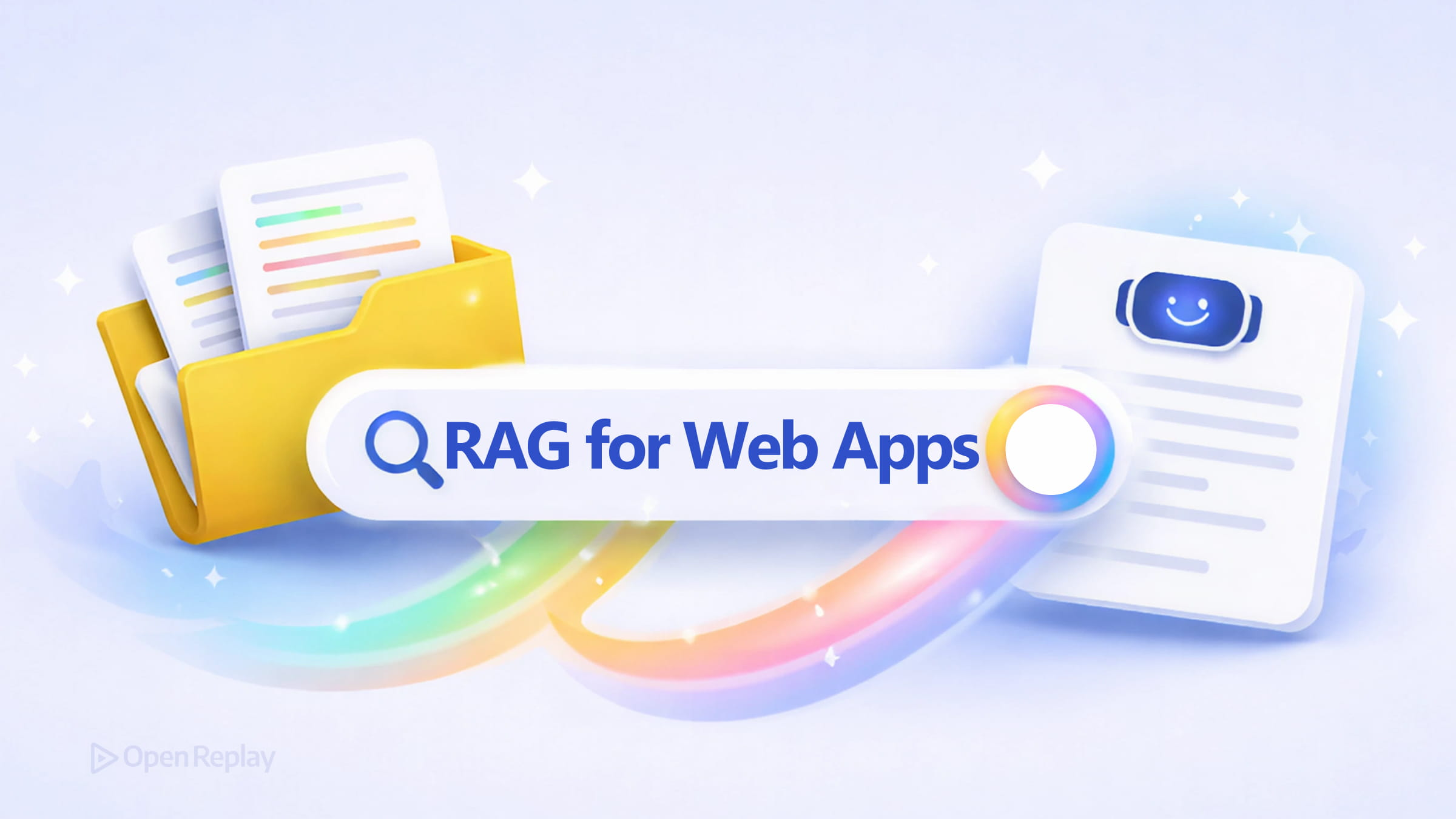
A Quick Introduction to RAG for Web Apps

You’re building an LLM-powered feature into your web app — a support chatbot, a documentation search tool, a product assistant. The model is capable, but it doesn’t know anything about your data. You could fine-tune it, but that’s expensive, slow to update, and overkill for most use cases.
Retrieval-Augmented Generation (RAG) solves this cleanly. It’s a widely used architectural pattern for grounding LLM responses in your own content, and it fits naturally into a modern web stack.
Key Takeaways
- RAG grounds LLM responses in your own data by retrieving relevant content at request time, removing the need to retrain or fine-tune for most web app use cases.
- A typical RAG pipeline involves ingesting and chunking documents, generating embeddings, storing them in a vector database, retrieving matching context, and passing it to the LLM for generation.
- RAG lives comfortably in a standard backend architecture — your frontend sends a query, the server handles retrieval and LLM calls, and the response streams back to the UI.
- Compared to fine-tuning, RAG is faster to ship, cheaper to maintain, and easier to update when your content changes frequently or is proprietary.
What Is RAG, and Why Does It Matter for Web Apps?
RAG combines two things: a retrieval system that fetches relevant content from a knowledge source, and a language model that uses that content to generate a response.
The key idea is simple: instead of relying solely on what the model learned during training, you supply it with relevant context at request time. The model answers based on what you give it — your docs, your data, your domain.
This matters for web applications because:
- Your data changes. Product catalogs, support articles, and policies update constantly. RAG lets you reflect those changes without retraining.
- Your data is private. The model was never trained on your internal knowledge base. RAG is how you bring it in.
- Users expect sourced answers. RAG makes it straightforward to return references alongside responses, which builds trust.
How the RAG Pipeline Works in a Web App
Building RAG pipelines for web apps follows a common pattern, regardless of the tools you use.
1. Ingest and chunk your documents Load your content — PDFs, Markdown files, database records, API responses — and split it into smaller chunks. Chunk size matters: too large and you retrieve noise, too small and you lose context. A common starting point is 512–1,024 tokens with some overlap between chunks.
2. Generate embeddings Each chunk is converted into a vector embedding using an embedding model. This numerical representation captures semantic meaning, so “cancel my subscription” and “how do I stop my plan” end up close together in vector space. Embeddings allow semantically similar text to be located efficiently during retrieval.
3. Store in a vector database Embeddings are stored in a vector store — options include Pinecone, Weaviate, Chroma, or pgvector if you’re already on Postgres. At query time, the user’s input is embedded and matched against stored vectors using similarity search.
4. Retrieve and assemble context The top-matching chunks are retrieved and assembled into a context block. More sophisticated pipelines add a reranking step here — a second model scores the retrieved chunks for relevance before passing them to the LLM. Hybrid search, combining keyword and semantic retrieval, is also worth considering when your content includes structured identifiers or exact terms.
5. Generate the response The assembled context, along with the original query, is passed to the LLM in a prompt. The model generates a response grounded in what you retrieved — not in general training data.
Discover how at OpenReplay.com.
RAG Architecture in Modern Web Apps
RAG architecture in modern web apps typically lives in the backend. Your frontend sends a query to an API route, the route handles retrieval and calls the LLM, and the response (often streamed) comes back to the UI.
You don’t need to build a custom orchestration stack from scratch. Frameworks such as LangChain and LlamaIndex can help with retrieval pipelines, document handling, and orchestration. Many AI SDKs and managed APIs now bundle retrieval directly, so the integration surface can be quite thin.
RAG vs. Fine-Tuning: A Practical Distinction
Fine-tuning adjusts model weights to change how the model behaves. RAG changes what information the model sees at inference time. For most web app use cases — especially where content updates frequently or data is proprietary — RAG is faster to ship, cheaper to maintain, and easier to update.
The two aren’t mutually exclusive, but RAG is usually the right first move.
Conclusion
RAG for web applications is less exotic than it sounds. It’s retrieval plus generation, wired into your existing request lifecycle. Once you understand the pipeline — ingest, embed, store, retrieve, generate — the implementation choices become straightforward. Start with RAG before reaching for fine-tuning, and you’ll have a grounded, maintainable AI feature running in your web app far sooner than you might expect.
FAQs
There is no universal number, but retrieving three to five chunks is a common starting point. Too few and the model may lack sufficient context. Too many and you risk exceeding the context window or diluting relevance with noise. Experiment with your specific content and measure answer quality to find the right balance.
Yes. RAG is model-agnostic. You can pair a local embedding model with an open-source LLM such as Llama or Mistral. The retrieval pipeline stays the same. The main trade-off is that self-hosted models require more infrastructure to run, but they give you full control over data privacy and cost.
The most common approach is to set up an ingestion pipeline that re-chunks and re-embeds updated documents, then upserts the new vectors into your store. You can trigger this on a schedule or in response to content changes via webhooks. Deleting stale vectors is equally important to avoid serving outdated information.
Pure vector search matches queries to documents based on semantic similarity using embeddings. Hybrid search combines this with traditional keyword matching. This is useful when your content contains exact identifiers like product codes or error numbers that semantic search alone might miss. Many modern vector databases and retrieval platforms now support hybrid search.
Understand every bug
Uncover frustrations, understand bugs and fix slowdowns like never before with OpenReplay — the open-source session replay tool for developers. Self-host it in minutes, and have complete control over your customer data. Check our GitHub repo and join the thousands of developers in our community.