Screen Recording Tools for Developers
Compare screen recording tools for developers: Loom, OBS, Screen Studio, CleanShot X, and SDK options for quick sharing, polished demos, and in-app capture.
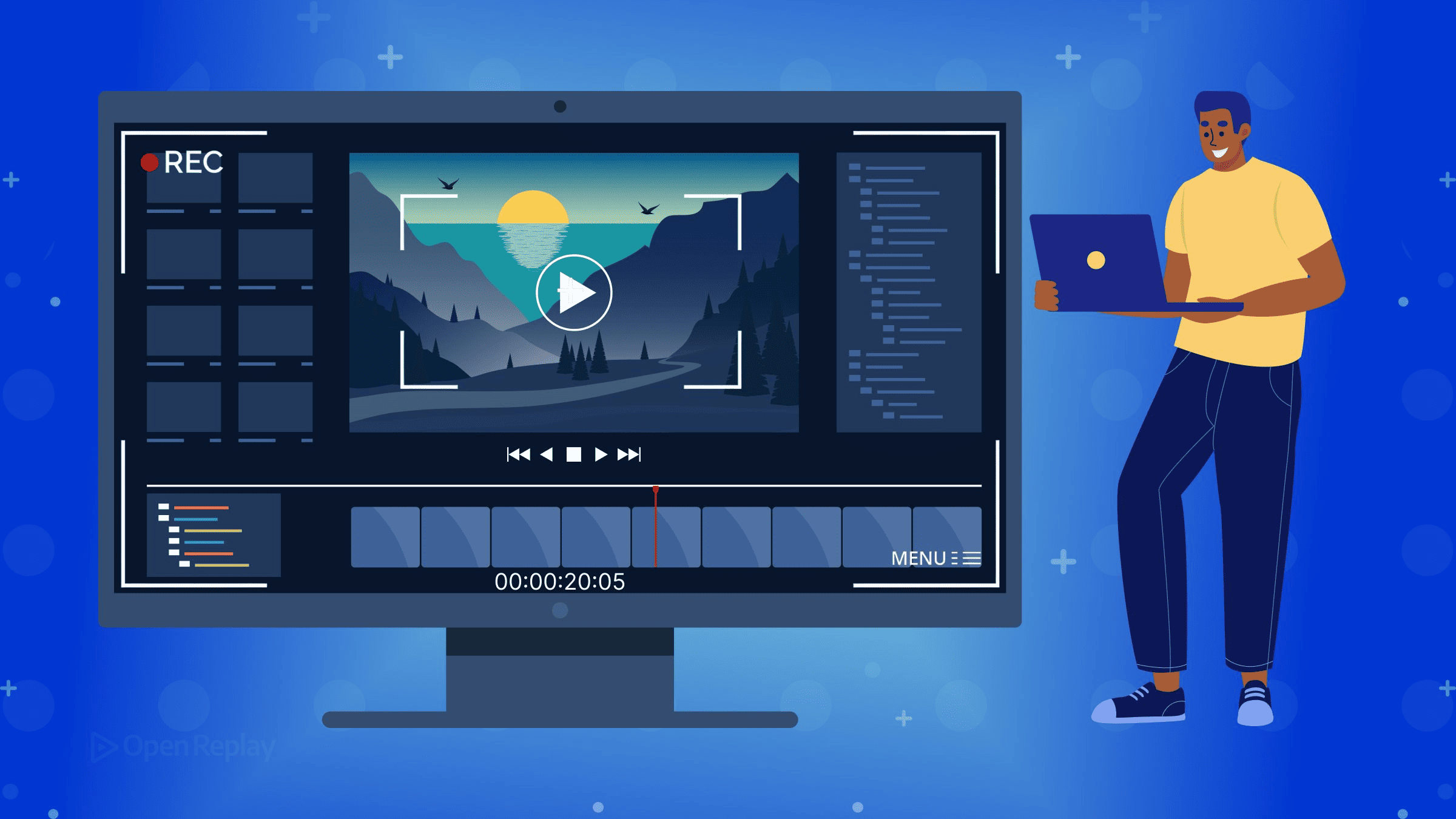
The best screen recorder for developers depends on the job: use Loom or Jumpshare for a fast record-and-share link, OBS Studio for free cross-platform capture of your terminal, IDE, and webcam in one scene, Screen Studio or CleanShot X for polished demo videos on Mac, and RecordRTC or an SDK when the recording needs to happen inside your own app.
Anyone who has recorded a walkthrough of a bug knows the small horror of watching it back and spotting a live API key sitting in the terminal for half the clip. That, more than frame rate or export presets, is what separates a recorder that works for engineering from one that doesn’t. This guide groups the tools by what you’re actually trying to do (quick share, polished demo, or embedded capture) and covers the OS limits and the credential-blurring options for each.
The criteria that separate these tools for engineering work are narrow: capture quality and CPU cost, cross-platform support, instant share links, the ability to blur credentials mid-recording, watermark-free output, and price. The rest is noise.
Key Takeaways
- OBS Studio (32.2.1 as of the current release notes) is free, open-source under GPL-2.0, and the only tool here that runs natively on Windows, macOS, and Linux while compositing your terminal, IDE, and webcam into a single watermark-free recording.
- The best “polished-demo” recorders (Screen Studio, CleanShot X, and Zappy) are macOS-only. Windows and Linux developers should default to OBS Studio, or ShareX on Windows.
- To avoid leaking API keys, hide sensitive regions during recording rather than in post: CleanShot X has built-in blur on macOS, while OBS has no blur filter of its own and relies on masking, cropping, or a third-party plugin.
- If you need recording inside your own app, that’s an SDK decision, not a desktop app: RecordRTC is a low-level MIT-licensed WebRTC library, while the Loom Record SDK and vendors like Velt ship higher-level components with hosting included.
- A screen recorder shows what you chose to film. A session-replay tool reconstructs what a real user actually did, including DOM changes, clicks, console errors, and network requests, without anyone hitting record.
What’s the best screen recorder for developers?
Group the tools by job and the choice gets obvious fast.
Discover how at OpenReplay.com.
Quick record and share. Loom is the default for pasting a video link into Slack, a PR, or Jira: record screen and webcam, and the upload link is ready when you stop. Its free Starter plan is capped at 25 videos per person, five minutes each, at 720p, and Loom is now owned by Atlassian, which acquired it in 2023; paid plans start at $18/user/month. Jumpshare is a close alternative that copies the share link to your clipboard automatically. On Mac, Zappy is free, fast, and does screenshots and looped GIFs through the same flow.
Free, open-source, and powerful. OBS Studio is the workhorse: free, GPL-2.0, and cross-platform (Windows 10 and 11, macOS 12 or newer, and Linux), with multi-source scene composition and live streaming. On Windows, ShareX is the lightweight counterpart: free, open-source under the GPL, watermark-free, with hotkey-driven capture and a wide range of upload destinations. It’s Windows-only.
Polished demo videos. Screen Studio pushes the frame in on whatever your cursor is doing and irons the jitter out of mouse movement, which gets you tutorial-grade output without touching a timeline. It’s subscription-only at $29/month or $9/month billed yearly ($108/year), macOS-only, with no permanent free tier: you record and edit for free but pay to export. CleanShot X is the Mac capture-and-annotate tool, $29 one-time including a year of updates (optional $19/year to renew) or a monthly subscription. Camtasia pairs recording with a full editor for Windows and Mac, sold as yearly subscription tiers rather than a single one-time license.
Transcription and AI. Descript transcribes what you record, and the transcript doubles as the timeline: cut a sentence from the text and it goes from the video. Its free plan is capped at one hour of media per month and exports at 720p with a watermark.
Recording with a built-in editor. Tella sits between the quick-share tools and a full editor: native macOS and Windows apps, a web recorder, a Chrome extension, transcript-based editing, one-click blur for anything sensitive on screen, and 4K export. It’s a hosted service rather than something you run yourself, and paid plans start at $13/month.
Developer-specific concerns most lists ignore
Two things matter more for engineering work than raw feature counts: not leaking secrets, and OS coverage.
Hide credentials during capture, not after. Post-hoc editing risks a single frame slipping through with an API key visible. CleanShot X offers built-in blur on macOS. OBS ships no general blur filter, so the live options are cropping the source, applying an image mask, or covering the region with another source; third-party plugins such as Composite Blur or StreamFX add real blur. The NVIDIA Blur filter in OBS is a different thing: it needs an NVIDIA GPU and targets webcam backgrounds, not a rectangle of your terminal.
Watch the OS trap. The best-in-class polished-demo tools are Mac-only. If you’re on Windows or Linux, OBS is your baseline; on Windows specifically, ShareX covers quick captures and GIFs.
| Tool | Windows | macOS | Linux | Free tier | Watermark-free |
|---|---|---|---|---|---|
| OBS Studio | ✅ | ✅ | ✅ | Free | ✅ |
| ShareX | ✅ | — | — | Free | ✅ |
| Loom | ✅ | ✅ | — | 25 × 5 min | ✅ |
| Zappy | — | ✅ | — | Free (local) | ✅ |
| Screen Studio | — | ✅ | — | Record only | n/a (paid) |
| CleanShot X | — | ✅ | — | None (30-day refund) | n/a (paid) |
| Camtasia | ✅ | ✅ | — | Trial | Paid tier |
| Descript | ✅ | ✅ | — | ~1 hr/mo | Paid tier |
OBS is also the tool that records terminal, IDE, and webcam into a single composited scene, which is why it’s the pick for bug reports and live coding.
Recording inside your own app is an SDK decision
If the requirement is “let users record from within our product,” a desktop app is the wrong category: you need a recording SDK. The build-vs-buy line is stark. RecordRTC is an MIT-licensed, low-level WebRTC library that handles audio, video, and screen capture in Chrome, Firefox, Opera, and Edge, on desktop and Android, with Safari limited to audio and video. It is also low-level and no longer actively maintained, so you build storage, transcoding, and playback yourself. A minimal client-side capture looks like this:
import RecordRTC from 'recordrtc';

// getDisplayMedia prompts the user to pick a screen/window/tab
const stream = await navigator.mediaDevices.getDisplayMedia({ video: true });

const recorder = new RecordRTC(stream, { type: 'video' });
recorder.startRecording();

// later, on stop:
recorder.stopRecording(() => {
  const blob = recorder.getBlob();
  // You own everything downstream: upload, transcode, store, serve.
});
The getDisplayMedia call is the standard browser API; RecordRTC just wraps the resulting MediaStream. Higher-level options carry the backend for you: the Loom Record SDK (@loomhq/record-sdk, Atlassian-owned) and commercial vendors like Velt or Zight ship prebuilt UI plus hosting. The tradeoff is weeks of infrastructure work versus a per-seat bill and less control.
What’s the difference between screen recording and session replay?
These solve different problems, and conflating them wastes time. A screen recorder captures what you choose to film and narrate: pixels and a voice track. It’s for authored communication like demos, walkthroughs, and async standups. A session-replay tool like OpenReplay reconstructs what a real user actually did in your app, including DOM mutations, clicks, console errors, and network requests, without anyone hitting record. Use a screen recorder to show something; use session replay to see what happened. A screen video of a bug shows the symptom; it can’t show the failed request or the console stack trace that a replay captures automatically. If the job is “explain this to a teammate,” reach for a recorder; if it’s “debug a user’s actual session,” that’s the session-replay category.
Pricing and free-tier limits in this space change constantly, so confirm every figure above on the vendor’s own pricing page before you buy. Start from the job: fastest share link points to Loom or Jumpshare, free and cross-platform points to OBS, Mac polish points to Screen Studio, and embedding recording in your product points to RecordRTC or an SDK.
FAQs
Does OBS Studio add a watermark to recordings?
No. OBS Studio produces watermark-free output on all platforms and is free under the GPL-2.0 license with no paid tier or export paywall. It's the reliable cross-platform choice for clean captures on Windows, macOS, and Linux. On Windows, ShareX is a second free, open-source, watermark-free option; Zappy is a free watermark-free choice on macOS. Loom's free plan is also watermark-free but caps videos at 25 recordings of five minutes each.
Can Windows or Linux developers use Screen Studio?
No. Screen Studio is macOS-only and has no Windows or Linux version. Its cursor auto-zoom and motion smoothing are macOS-exclusive, as are the other polished-demo tools CleanShot X and Zappy. Windows and Linux developers should default to OBS Studio for cross-platform capture, and Windows users can add ShareX for quick screenshots and GIFs. There is no direct cross-platform equivalent that matches Screen Studio's automated zoom effects.
How do I blur an API key or password while screen recording?
Hide sensitive regions during recording rather than editing them out afterward, because post-hoc editing risks a single frame slipping through with credentials visible. On macOS, CleanShot X offers built-in blur applied live. OBS Studio has no general-purpose blur filter: you either crop the source, apply an image mask, or cover the region with another source, or you install a third-party blur plugin. Setting that up before you hit record is the safest approach for demos that touch dashboards, terminals, or environment variables.
What's the difference between RecordRTC and the Loom Record SDK?
RecordRTC is a low-level, MIT-licensed WebRTC library that captures audio, video, and screen in Chrome, Firefox, Opera, and Edge, but leaves storage, transcoding, playback, and UI for you to build, and it is no longer actively maintained. The Loom Record SDK, published as @loomhq/record-sdk and owned by Atlassian, is a higher-level package that ships prebuilt UI plus hosting. The tradeoff is weeks of infrastructure work with full control versus a per-seat bill with the backend handled.