Why You Should Be Careful with `!` in TypeScript

TypeScript’s null safety features are one of its strongest selling points. With strictNullChecks enabled, the compiler forces you to handle cases where a value might be null or undefined before using it. But there’s a single character that lets you bypass all of that: !.
The non-null assertion operator is easy to reach for when the compiler complains. Understanding what it actually does — and what it doesn’t do — will save you from bugs that are genuinely hard to track down.
Key Takeaways
- The
!(non-null assertion) operator tells the TypeScript compiler to treat a value as non-null, but it generates no runtime check whatsoever — it is erased entirely in the emitted JavaScript. - Overusing
!undermines the purpose ofstrictNullChecksby converting compile-time errors into runtime crashes. - Safer alternatives like explicit null checks, optional chaining (
?.), nullish coalescing (??), and custom assertion guards should be your first choice. - Reserve
!for cases where you have genuine external knowledge the compiler cannot verify, and treat every instance as a code review flag.
What the TypeScript ! Operator Actually Does
When you append ! to an expression, you’re telling the TypeScript compiler: “Trust me, this value is neither null nor undefined.” The compiler removes null and undefined from the type and stops complaining.
// With strictNullChecks enabled
const input = document.querySelector('input') // type: HTMLInputElement | null
const value = input!.value // type: string — compiler is satisfied
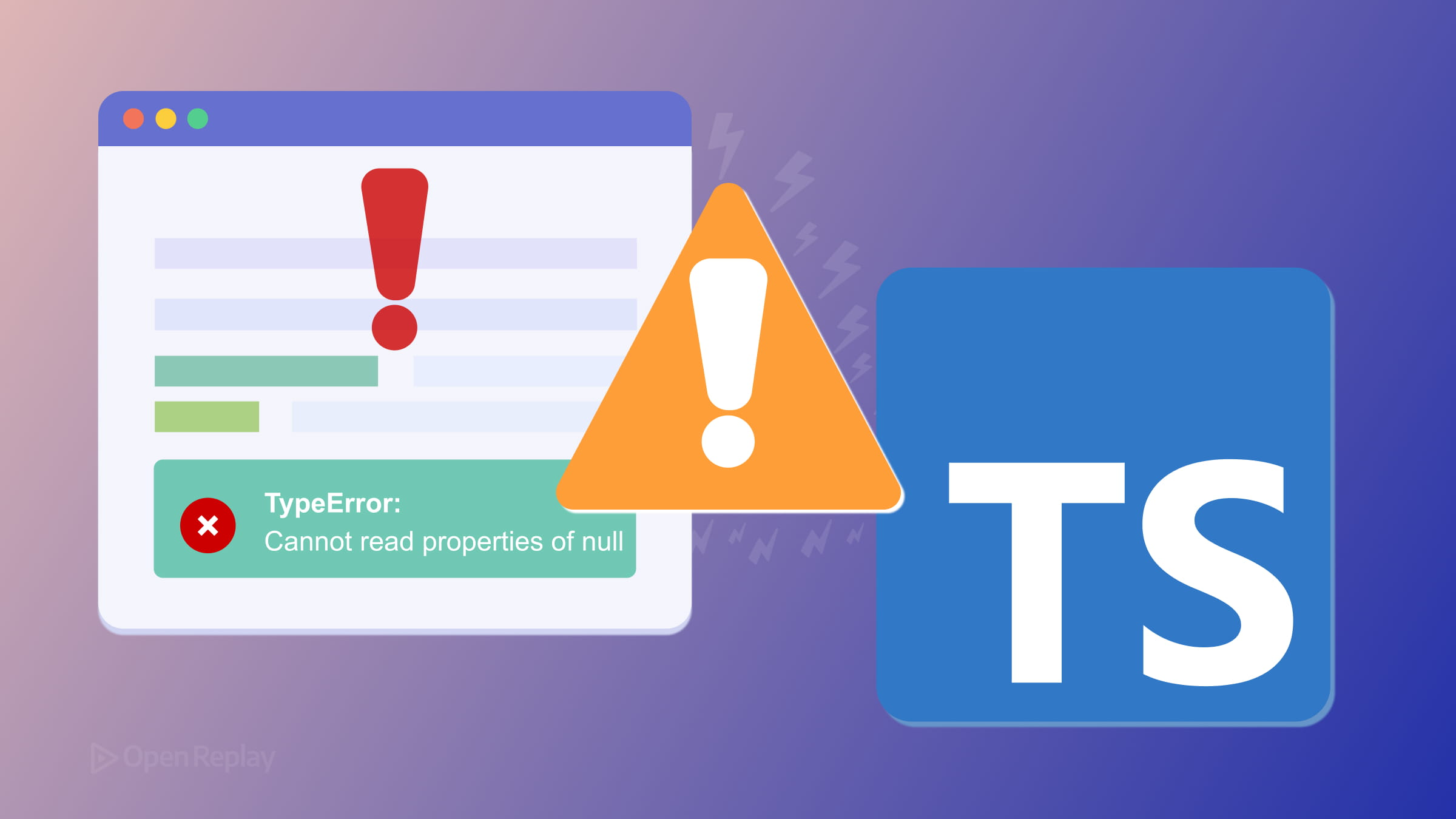
Here’s the critical part: ! is erased entirely in the emitted JavaScript. There is no runtime check. No guard. No safety net. If input is actually null at runtime, you’ll get the same Cannot read properties of null error you were trying to avoid in the first place.
Definite Assignment Assertion vs. Non-Null Assertion
The ! operator appears in two distinct contexts, and it’s worth distinguishing them.
Non-null assertion — used on expressions to strip null | undefined from the type:
const el = document.getElementById('app')! // HTMLElement, not HTMLElement | nullDefinite assignment assertion — used in class fields or variable declarations to tell the compiler a property will be assigned before use, even if it can’t verify that:
class UserService {
  user!: User // "I promise this will be assigned before it's read"
}
Both are compile-time assertions that silence the compiler without adding any runtime protection. The non-null assertion removes null | undefined from an expression’s type, while the definite assignment assertion disables definite assignment checks for a variable or class field.
Why Overusing ! Undermines TypeScript Null Safety
The ! operator is an escape hatch, not a solution. When you use it, you’re not fixing a nullability problem — you’re hiding it from the compiler while leaving it fully intact at runtime.
A common pattern that causes real bugs:
// Dangerous: assumes the element always exists
const button = document.querySelector('.submit-btn')!
button.addEventListener('click', handleSubmit)
If that element doesn’t exist in a particular context — a different page, a conditional render, a test environment — you get a runtime crash. The compiler gave you no warning because you told it not to.
Discover how at OpenReplay.com.
Safer Alternatives Worth Using First
Modern TypeScript has strong control-flow analysis. In many situations where developers historically reached for !, the compiler can now narrow types automatically with a simple guard.
Explicit null check:
const button = document.querySelector('.submit-btn')
if (button) {
  button.addEventListener('click', handleSubmit)
}
Optional chaining with nullish coalescing:
const label = document.querySelector('label')?.textContent ?? 'Default'Type guard function:
function assertExists<T>(
  val: T | null | undefined,
  msg: string
): asserts val is T {
  if (val == null) throw new Error(msg)
}

const el = document.getElementById('app')
assertExists(el, 'App element not found')
el.style.display = 'block' // narrowed to HTMLElement
The assertion guard approach is particularly useful because it preserves the safety guarantee — if the value is null, you get an explicit, descriptive error at the point of failure rather than a cryptic crash somewhere downstream.
When ! Is Actually Appropriate
There are legitimate uses. If you have external knowledge the compiler cannot infer — for example, a value guaranteed by an initialization lifecycle that TypeScript can’t trace — ! is a reasonable tool. The key question is: do you actually know something the compiler doesn’t, or are you just silencing a warning?
If it’s the latter, the warning is probably right.
Conclusion
The TypeScript ! operator doesn’t make your code safer — it makes it quieter. Used carelessly, it converts compile-time errors into runtime crashes, which is the opposite of what strictNullChecks is designed to prevent. Reach for control-flow narrowing, optional chaining, or explicit guards first. Reserve ! for cases where you have genuine certainty the compiler can’t verify, and treat every instance as a code review flag worth examining.
FAQs
No. The exclamation mark is stripped entirely during compilation. The emitted JavaScript contains no null check or guard of any kind. If the value turns out to be null or undefined at runtime, your code will throw an error exactly as if you had never used TypeScript at all.
It can be. When you write a property like user!: User, you are telling the compiler the value will be assigned before any code reads it. If that assumption is wrong — for example, if an expected initialization step is skipped — accessing the property will return undefined and likely cause a runtime error with no compile-time warning.
It is reasonable when you have external knowledge the compiler cannot verify. A common example is when a value is guaranteed by an initialization lifecycle that TypeScript cannot trace (for example, framework initialization hooks or dependency injection). Even then, consider using an explicit assertion guard instead, so that a missing value produces a clear error message rather than a cryptic crash.
The best alternative depends on context. For DOM lookups and optional data, use optional chaining with nullish coalescing. For cases where a missing value is a true error, use a custom assertion guard function that throws a descriptive message. Both approaches preserve type narrowing while adding real runtime safety.
Complete picture for complete understanding
Capture every clue your frontend is leaving so you can instantly get to the root cause of any issue with OpenReplay — the open-source session replay tool for developers. Self-host it in minutes, and have complete control over your customer data.
Check our GitHub repo and join the thousands of developers in our community.