Useful Color Tools for Frontend Developers

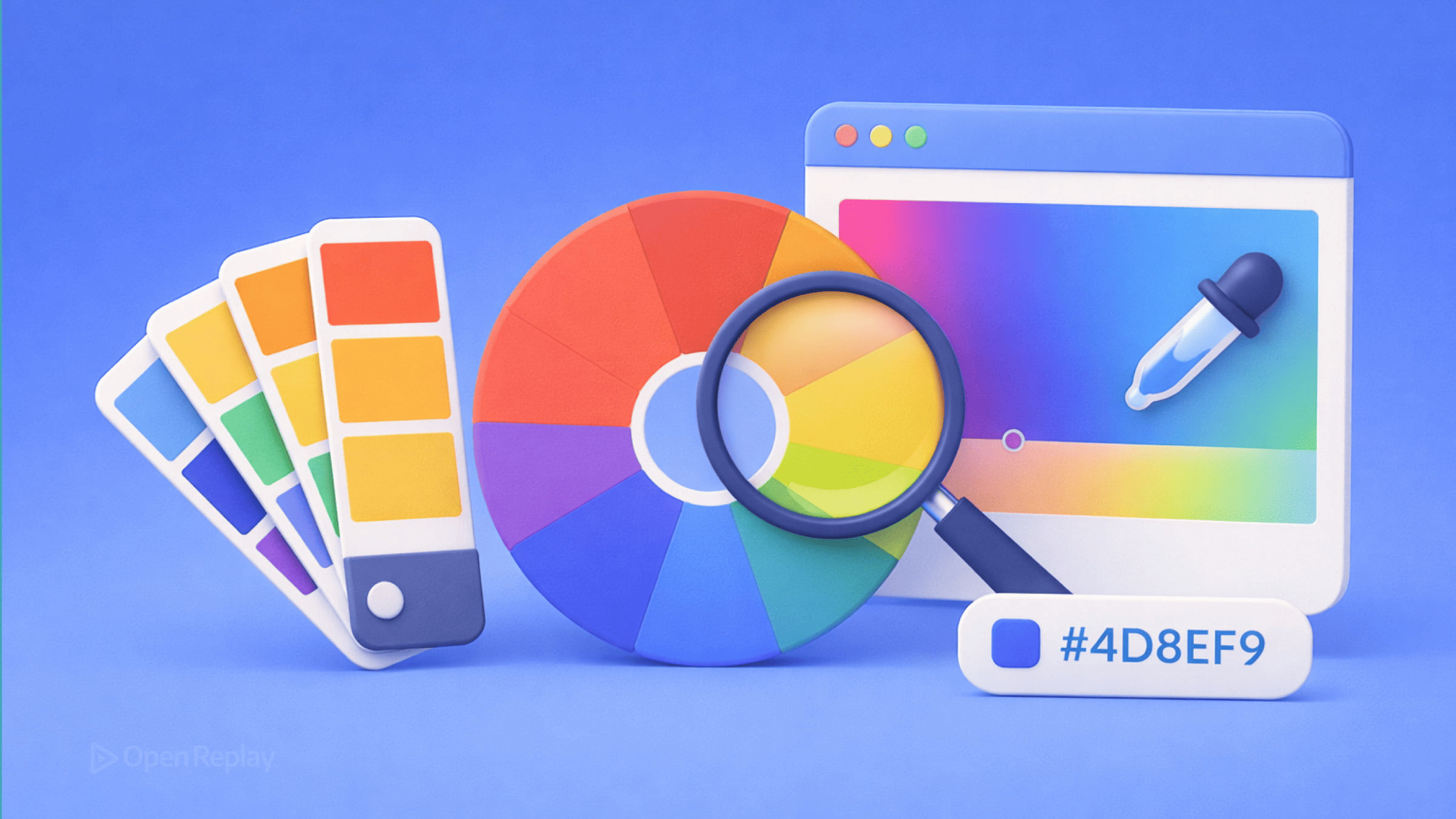
Picking colors for a UI sounds simple until you need consistent tints across light and dark themes, accessible contrast ratios, and values that work in modern color spaces. The tooling landscape has shifted. OKLCH and OKLab are now the baseline for perceptually uniform color work, color-mix() is supported in current versions of all major browsers, and DevTools have become legitimate color utilities. Here’s what’s actually useful in 2025.
Key Takeaways
- Browser DevTools now handle OKLCH, OKLab, and Display-P3 natively, making them sufficient for most day-to-day color work.
- OKLCH-native tools like OKLCH Picker, Huetone, and Leonardo provide perceptually consistent palette generation that HSL cannot match.
- The
color-mix()function and relative color syntax have changed how we handle color variations in CSS, with tools like Color.js offering interactive playgrounds for prototyping. - WCAG 2.x contrast ratios remain the legal standard for accessibility compliance, even as APCA gains traction for internal guidance.
Browser DevTools as Modern Color Pickers for Developers
Before reaching for external tools, check what’s already in your browser. Chrome, Firefox, and Safari DevTools now handle OKLCH, OKLab, and Display-P3 natively.
Chrome DevTools lets you click any color value in the Styles panel to open a picker that converts between formats on the fly. You can switch a hex value to oklch() instantly, adjust lightness with perceptually accurate sliders, and see gamut warnings when colors fall outside sRGB. The contrast ratio indicator shows WCAG 2.x compliance against the computed background.
Firefox DevTools offers similar functionality with its color picker, including format conversion and modern color-space editing.
Safari DevTools supports wide-gamut (Display-P3) color workflows in recent versions, which matters when targeting Apple devices.
For day-to-day work—tweaking a token, checking a ratio, converting formats—DevTools are often enough.
OKLCH Color Tools for Palette Generation
When you need to generate full palettes or explore color relationships, dedicated OKLCH color tools fill the gap.
OKLCH Picker by Evil Martians remains the reference tool. It visualizes the OKLCH color space, shows gamut boundaries for sRGB and P3, and exports to CSS. The lightness slider behaves predictably—a 10% change in L looks like a 10% change, unlike HSL.
Huetone generates entire color scales with consistent perceptual steps. You define endpoints, and it interpolates through OKLCH to produce tints and shades that don’t shift hue unexpectedly. This proves useful for design system work where you need 10 shades of a brand color.
Leonardo by Adobe takes a contrast-first approach. You specify target contrast ratios, and it calculates colors that meet them. It supports OKLCH internally and exports to multiple formats.
CSS Color-Mix Tools and Relative Color Syntax
The color-mix() function and relative color syntax have changed how we handle color variations in CSS. A few tools help you prototype these values before committing them to code.
Color.js isn’t a visual tool—it’s a library—but its documentation site includes an interactive playground. You can test color-mix() expressions, relative color syntax, and conversions between any color space. When you need to understand what color-mix(in oklch, var(--brand) 70%, white) actually produces, this is where to check.
For visual palette exploration in OKLCH specifically, use OKLCH Picker or Huetone — both are built around perceptual color work and make it easy to export CSS-ready values.

Discover how at OpenReplay.com.
Frontend Color Accessibility Tools
Accessibility tooling requires precision. For production compliance, WCAG 2.x contrast ratios (4.5:1 for normal text, 3:1 for large text) remain the standard.
WebAIM Contrast Checker is straightforward: enter two colors, get the ratio, see pass/fail for AA and AAA. It accepts hex, RGB, and HSL.
Stark integrates with Figma, Sketch, and browsers. Beyond contrast checking, it simulates color vision deficiencies—useful for catching issues that ratios alone won’t reveal.
Polypane includes contrast checking in its accessibility panel, with the advantage of testing against actual rendered backgrounds rather than assumed values.
A note on APCA: The Advanced Perceptual Contrast Algorithm appears in some tools as an alternative metric. It’s more accurate for predicting readability, but WCAG 2.x ratios remain the legal and compliance standard. Use APCA for internal guidance if you prefer, but use WCAG ratios for documentation and audits.
Design System Considerations
If you’re building or maintaining a design system, the trend toward OKLCH-based tokens is worth noting. Systems like Open Props define color scales in OKLCH, making it easier to generate consistent variants with color-mix() or relative color syntax.
Tailwind CSS v4 has moved toward OKLCH internally for its default palette generation, though it still outputs values in formats your config specifies.
Conclusion
For quick checks and conversions, browser DevTools handle most needs. For palette generation with perceptual consistency, OKLCH-native tools like Huetone or Leonardo are worth the context switch. For accessibility compliance, stick with established WCAG 2.x checkers.
The tools have caught up with the specs. The main shift is treating OKLCH and color-mix() as defaults rather than experiments—your tooling should reflect that.
FAQs
OKLCH is perceptually uniform, meaning equal numeric changes produce equal visual changes. In HSL, a 10% lightness change can look dramatically different depending on the hue. OKLCH makes palette generation more predictable because colors maintain consistent visual relationships across the spectrum.
As of 2025, OKLCH and color-mix() have broad support across Chrome, Firefox, Safari, and Edge. For older browser support, you can provide fallback values in hex or RGB. If you need legacy support, you can provide fallback values in hex or RGB, and some build-tool plugins can help generate or manage those fallbacks.
WCAG 2.x ratios remain the legal and compliance standard for accessibility audits. APCA provides more accurate readability predictions but isn't yet part of official guidelines. Use WCAG ratios for documentation and compliance, and consider APCA as supplementary internal guidance.
Modern browsers will clamp out-of-gamut colors to the nearest displayable value on standard monitors. Use DevTools or OKLCH Picker to see gamut boundaries. For wide-gamut displays, you can use Display-P3 colors, but always test how they degrade on sRGB screens.
Truly understand users experience
See every user interaction, feel every frustration and track all hesitations with OpenReplay — the open-source digital experience platform. It can be self-hosted in minutes, giving you complete control over your customer data. . Check our GitHub repo and join the thousands of developers in our community..