Technologies Worth Watching in 2026

The JavaScript ecosystem in 2026 isn’t about revolutionary new frameworks. It’s about the tools you already know finally working the way they should.
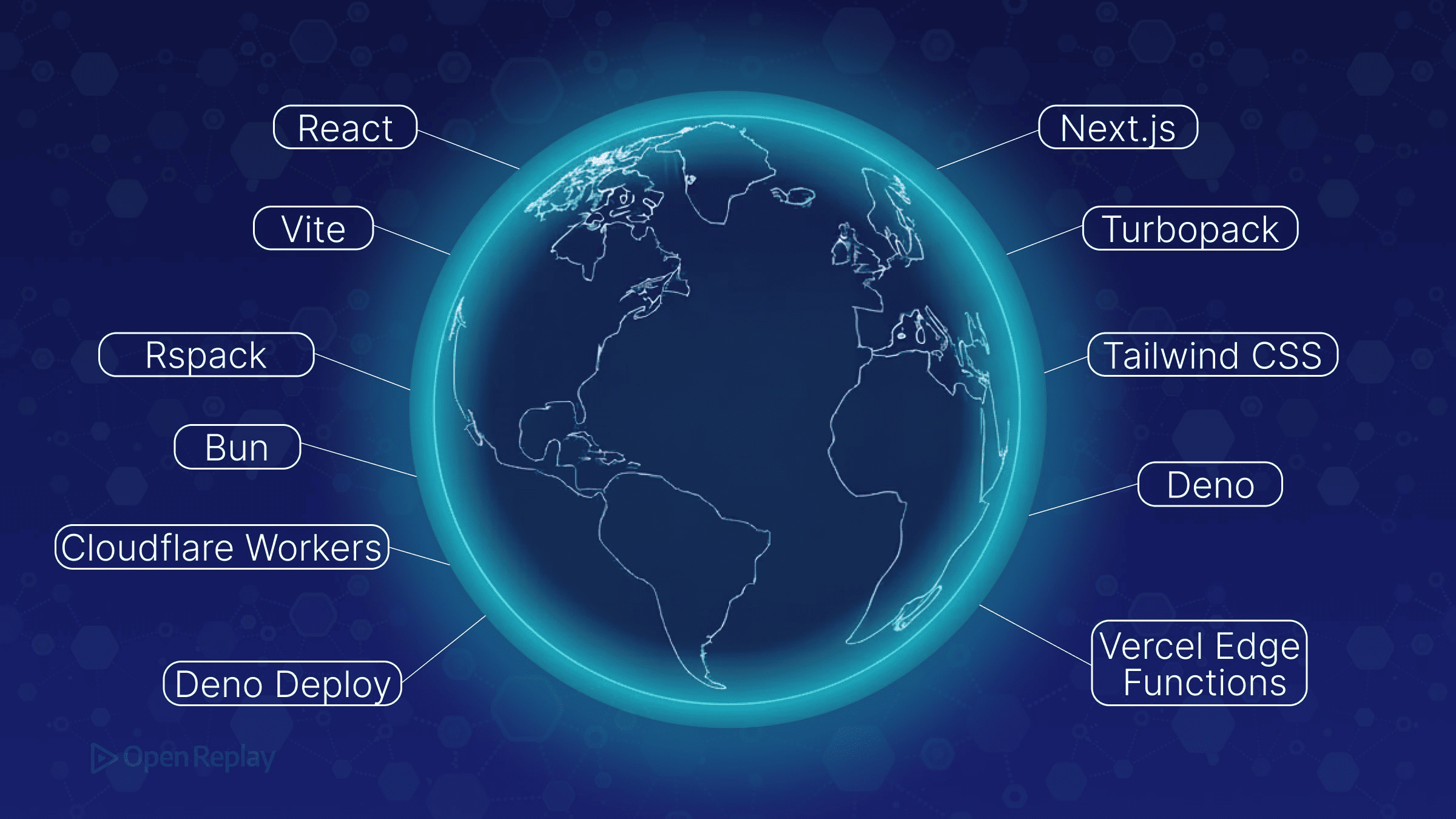
React 19, Next.js 16, Vite 7, and Tailwind CSS v4 are now baseline expectations. The interesting question isn’t what’s new—it’s which emerging patterns will actually change how you build production applications this year.
This article covers the frontend trends 2026 teams should pay attention to: technologies that shipped in late 2025 and are now mature enough to evaluate seriously.
Key Takeaways
- Server-first rendering with React Server Components is now production-ready and reduces client bundle sizes significantly
- Build tools like Vite 7, Turbopack, and Rspack compete on speed, delivering near-instant hot module replacement
- Native CSS features (container queries,
:has(), cascade layers, nesting) are well supported in modern browsers - Runtime diversity is real—Bun and Deno are viable alternatives to Node.js for specific use cases
- AI coding assistants are workflow staples, best used for boilerplate and repetitive tasks rather than architecture decisions
- Edge computing has found its niche in latency-sensitive workloads like authentication and personalization
Server-First Rendering Reaches Maturity
React Server Components (RSC) spent years in experimental limbo. That phase is largely over for teams operating within the React and Next.js ecosystem.
With React 19 stable and Next.js 16 treating RSC as the default, server-first rendering is no longer optional knowledge. The mental model shift—components that never ship JavaScript to the client—is now something every frontend developer needs to understand.
What’s working well:
- Dramatic reductions in client bundle size for content-heavy applications
- Simplified data fetching patterns (no more
useEffectwaterfalls) - Better initial page loads, especially on slower connections
Where it’s still evolving:
- Debugging server/client boundaries remains tricky
- Third-party library compatibility varies
- Teams need clear conventions for when to use
'use client'
Server actions follow a similar trajectory. They’re production-ready but require careful security review—validating inputs and handling authentication on every action, not just at the route level.
Build Tooling Consolidates Around Speed
Vite 7 and Turbopack represent a broader web development trend in 2026: build tools competing primarily on speed and developer experience rather than features.
The practical impact? Hot module replacement that actually feels instant. Cold starts measured in milliseconds. Builds that don’t punish large codebases.
Rspack deserves attention here too. It’s webpack-compatible but Rust-powered, offering a migration path for teams with heavy webpack investments who want modern performance.
For most new projects, Vite remains the default choice. But the ecosystem is healthy enough that switching costs between tools are dropping.
CSS Gets Genuinely Powerful
The CSS features that felt experimental in 2024 are now well supported in modern browsers:
- Container queries: Components that respond to their parent’s size, not just the viewport
:has()selector: Parent selection without JavaScript- Cascade layers: Explicit control over specificity conflicts
- Native nesting: Less reason to reach for preprocessors
Tailwind CSS v4’s move to a CSS-first architecture reflects this shift. The framework now generates standard CSS custom properties, making integration with native CSS features seamless.
For frontend trends in 2026, this means fewer runtime style calculations and more work pushed to the browser’s optimized CSS engine.

Discover how at OpenReplay.com.
Runtime Diversity Becomes Normal
Node.js remains the default, but Bun and Deno are no longer curiosities. They’re viable choices for specific use cases.
Bun’s speed advantages matter for local development and edge deployments. Deno’s security model and TypeScript-first approach appeal to teams prioritizing those concerns.
The practical implication: your code should avoid Node-specific APIs when possible. The JavaScript ecosystem in 2026 rewards portability.
AI Tooling Enters the Workflow
AI coding assistants like Cursor and GitHub Copilot are past the novelty phase. The question isn’t whether to use them—it’s how to use them effectively.
What’s proving valuable:
- Boilerplate generation and repetitive refactoring
- Explaining unfamiliar codebases
- Generating test cases from implementation code
What still requires human judgment:
- Architecture decisions
- Security-sensitive code
- Performance-critical paths
The technologies to watch in 2026 include AI tools that integrate deeper into the development workflow—not replacing developers, but handling the mechanical work that slows teams down.
Edge Computing Finds Its Niche
Edge functions aren’t replacing traditional servers. They’re handling specific workloads where latency matters: authentication, personalization, A/B testing, and geolocation-based routing.
Platforms like Cloudflare Workers, Vercel Edge Functions, and Deno Deploy have matured enough that edge deployment is a configuration choice, not an architecture overhaul.
The constraint to remember: edge runtimes have limited APIs and cold start considerations. They’re a tool, not a universal solution.
Conclusion
The web development trends in 2026 share a common theme: the infrastructure is catching up to developer expectations.
Server components work. Build tools are fast. CSS handles layout complexity natively. Multiple runtimes are production-ready.
The opportunity isn’t adopting bleeding-edge experiments. It’s leveraging stable tools that finally deliver on their promises—and building teams that understand when each tool fits.
Focus on fundamentals. Ship incrementally. Let the hype cycles pass.
FAQs
Not necessarily. Server Components offer the biggest gains for content-heavy applications with large client bundles. If your app is highly interactive with minimal static content, the migration effort may not justify the benefits. Evaluate your specific use case, measure your current bundle size, and consider a gradual adoption starting with new features rather than a full rewrite.
Bun is production-ready for many use cases, particularly local development tooling and edge deployments where its speed advantages shine. However, Node.js still has broader ecosystem compatibility and longer production track record. Consider Bun for new projects where its strengths align with your needs, but avoid forcing a migration on stable Node.js applications without clear benefits.
For new projects without legacy constraints, Vite offers the best balance of speed, ecosystem support, and documentation. Choose Turbopack if you're building with Next.js and want tight integration. Pick Rspack when migrating from webpack and need compatibility with existing configuration. All three deliver excellent performance, so prioritize ecosystem fit over raw benchmarks.
Yes, but with boundaries. AI assistants excel at generating boilerplate, writing tests, and explaining unfamiliar code. They struggle with architecture decisions, security-sensitive logic, and performance optimization. Treat them as productivity tools for mechanical tasks rather than replacements for engineering judgment. Review all generated code carefully before committing.
Gain Debugging Superpowers
Unleash the power of session replay to reproduce bugs, track slowdowns and uncover frustrations in your app. Get complete visibility into your frontend with OpenReplay — the most advanced open-source session replay tool for developers. Check our GitHub repo and join the thousands of developers in our community.