Method Chaining in JavaScript: Pros and Cons
Method chaining in JavaScript: see how it works, when it helps readability, and when long chains hurt debugging, async flow, and performance.

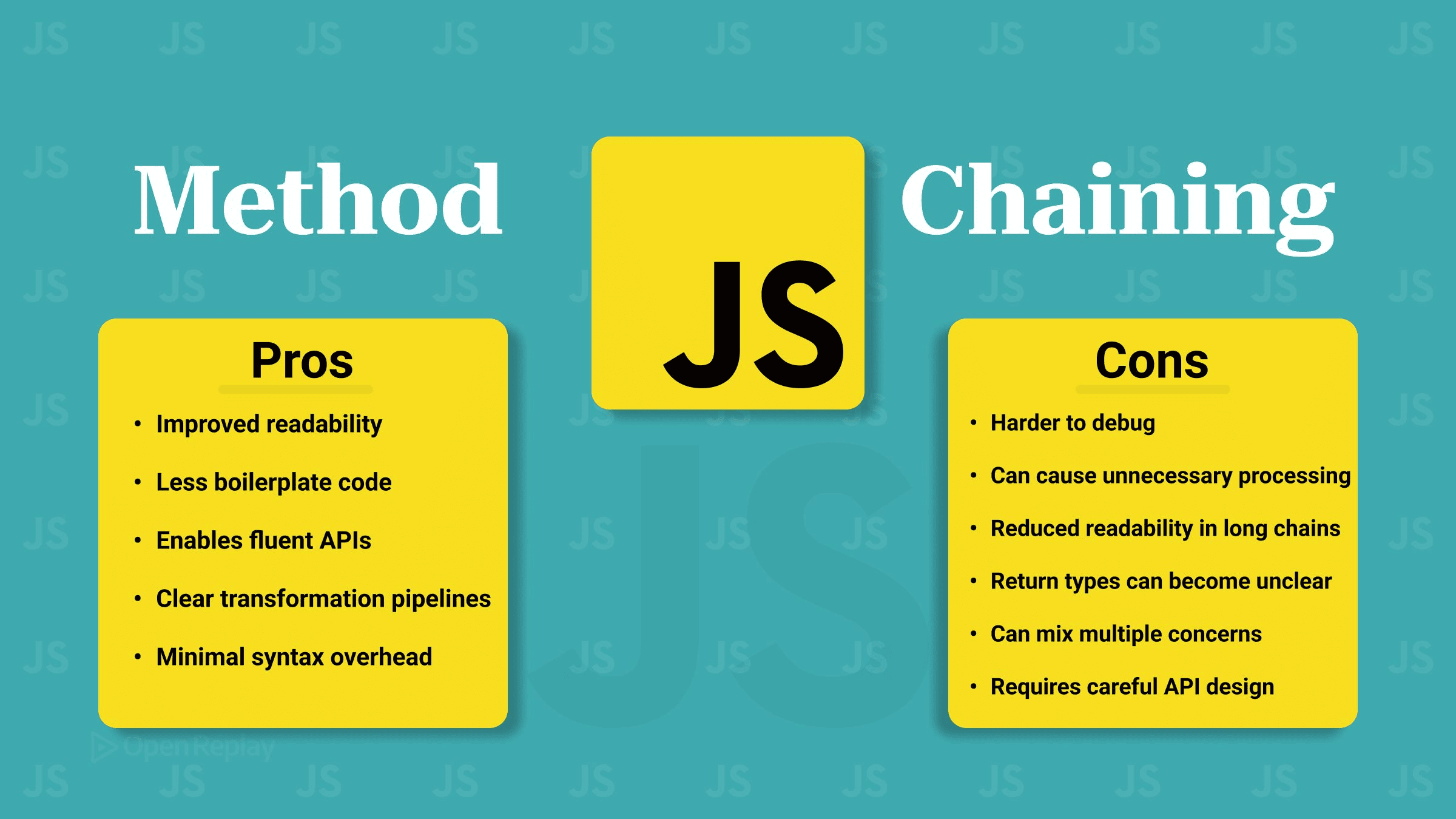
Method chaining is calling several methods on the same object in one sequence, and it works because each method returns an object that still has methods to call.
If you have ever stared at a six-step chain that quietly returns undefined, with nowhere obvious to put a breakpoint, you already know the trade-off. The dots are cheap to write and expensive to unpick. For built-ins like array and string methods, the return value carries the next method; for your own objects, each method ends with return this. Chaining is a readability tool, not a default. It earns its place on short pipelines and starts to cost you on long ones. This article covers the mechanism, the genuine pros, the real cons (debugging friction, wasted work, muddled async), how to build your own chainable object correctly, and a concrete rule for when to stop.
Key Takeaways
- Method chaining works because each method returns an object with more methods; built-ins return a new value that carries the next method, and custom objects chain by ending each method with
return this. - Chaining itself has negligible performance cost; the real cost is extra passes and allocations, as when
.filter().map()[0]makes two full array passes while.find()makes one and stops at the first match. - An arrow-function method breaks chaining because it has no
thisof its own, so it never points at the instance, andcall,bind, andapplywill not change that. - A practical rule: one step is always fine, two is usually fine, three or four should give you pause, and five or more should be broken into named steps.
- Chaining optimizes for writing speed; naming intermediate values optimizes for reading and debugging later, and those are not the same goal.
What is method chaining and how does it work?
Method chaining works because each method returns an object that still has methods to call. Built-in array and string methods return a new value (an array, a string) that carries its own methods, so you can keep going:
const topNames = users
  .filter(user => user.active)
  .map(user => user.name)
  .sort();
filter returns an array, so map is available; map returns an array, so sort is available. For your own objects, you reproduce this by returning the instance from each method:
class QueryBuilder {
  constructor() { this.parts = []; }
  where(clause) { this.parts.push(`WHERE ${clause}`); return this; }
  limit(n) { this.parts.push(`LIMIT ${n}`); return this; }
  build() { return this.parts.join(" "); }
}

new QueryBuilder().where("active = 1").limit(5).build();
// "WHERE active = 1 LIMIT 5"
Because where and limit return this, the next method resolves against the same instance. This is the same principle that powers fluent builder APIs.
Discover how at OpenReplay.com.
The pros: readable pipelines and fluent APIs
Chaining is at its best on short pipelines where the steps form one clear transformation. It reads left-to-right as a sequence (filter, then map, then sort) and it avoids naming throwaway intermediate variables you never reference again. For a two-step transform, a chain is often the most direct expression of intent:
const activeNames = users.filter(u => u.active).map(u => u.name);Fluent and builder APIs lean on the same mechanism to read like sentences: query.where(...).limit(...).build() or expect(value).to.be.an('array'). When the whole chain describes a single coherent operation, the syntax is doing real work for the reader.
The cons: debugging, wasted work, and muddled async
The costs of chaining show up when the chain gets long, mixes concerns, or hides how much work it does. These are the reasons not to reach for a chain by default.
Debugging friction. The hardest chains to debug are the ones that produce a wrong final value, because there’s no natural place to set a breakpoint or log an intermediate without taking the chain apart. You end up inlining a console.log into a callback, mixing debug code with logic, or breaking the chain into steps anyway. In production frontend code this is a common failure mode: you can see the wrong output but not which step produced it. Session replay helps here: replaying the interaction that produced the bad state gives you back the inputs a collapsed chain hides, the same information that splitting the chain into named steps would have exposed.
Wasted work. Chaining nudges you toward “process everything,” even when that’s not what you meant. .filter().map()[0] makes two full passes over the array and allocates an intermediate array, then throws away all but one element. When you only want the first match, Array.prototype.find() is the right tool. It walks the array only until the callback accepts an element, hands that element back, and goes no further:
const name = users.find(u => u.active)?.name;Return-type opacity. In a long chain like data.transform().normalize().validate().save(), you have to track what each step returns with no type annotations at runtime. When a step in the middle returns something unexpected, the whole chain silently changes shape.
Muddled async. Mixing async control flow with data transforms in one .then() chain blurs intent. Splitting fetching and parsing from the transformation reads more clearly:
const res = await fetchUsers();
const users = await res.json();
const activeNames = users.filter(u => u.active).map(u => u.name);
This is a readability judgment, not a performance one. await and .then() do the same work.
Performance: the dots are free, the passes aren’t
Chaining itself has negligible intrinsic performance cost: a method call plus a property access per step is trivial next to the work of iterating a collection. What actually costs you is doing more work than you need. .filter().map()[0] is two full O(n) passes plus an intermediate array; find() is one pass that stops early. The lesson is to count iterations and allocations, not dots. A five-method chain that traverses the data once can be faster than a two-method chain that traverses it twice. Reach for short-circuiting methods like find and some whenever you only need the first qualifying result.
How do you build your own chainable API?
To make an object chainable, return this from every method that should continue the chain. The one gotcha that reliably breaks it is writing a method as an arrow function. An arrow never gets a this of its own; it borrows whatever this the surrounding code had when the arrow was written, so return this hands back the wrong object, and passing the function through call, bind, or apply will not change that.
const counter = {
  count: 0,
  // Broken: arrow `this` is the enclosing scope, not `counter`
  incArrow: () => { this.count++; return this; },
  // Correct: method shorthand binds `this` to the instance
  inc() { this.count++; return this; }
};

counter.inc().inc(); // works, count === 2
Both classes and prototypes support the same pattern. If you prefer to declare state as a class field (parts = []) instead of assigning it inside the constructor, that syntax has been standard since ES2022. The prototype version behaves identically:
// Prototype form — identical behavior
function Query() { this.parts = []; }
Query.prototype.where = function (c) { this.parts.push(c); return this; };
Use a class for new code; the prototype form is worth knowing for older codebases and for understanding what the class desugars to.
A rule of thumb for chain length
Chaining optimizes for writing speed; naming intermediate values optimizes for reading and debugging later, and those are not the same goal. A practical rule for length:
| Chain length | Do this | Why |
|---|---|---|
| 1 step | Chain freely | Nothing to untangle |
| 2 steps | Usually fine | Still one clear transformation |
| 3–4 steps | Pause; consider naming an intermediate | Readability and breakpoint access start to suffer |
| 5+ steps | Break into named steps | Return types and concerns are hard to track |
Break a chain apart when you’re actively debugging, when a step’s return type is unclear, or when the chain mixes async control flow with data transformation. And prefer a short-circuiting find or some over filter-then-index whenever you only want one result.
Chain a sequence when the steps read as one transformation and stay short; name your intermediates the moment the chain grows past three or four steps or starts doing more work than you asked for. Next time a chain crosses that line, split it. Your future self reading the code will spend less time decoding and more time fixing.
FAQs
Is method chaining slower than calling methods separately?
No. Chaining has negligible intrinsic cost because a method call plus a property access per step is trivial compared to iterating a collection. Performance comes from how many passes and allocations you make over the data, not from the dots. A chain that traverses the data once can be faster than separate calls that traverse it twice.
Why does chaining break when a method is written as an arrow function?
An arrow function never gets a 'this' of its own. It borrows the 'this' of the code around it, so 'return this' hands back the wrong object and the next method has nothing valid to resolve against. Passing the function through call, bind, or apply will not fix it either, because those methods cannot give an arrow a new 'this'. Use method shorthand or a regular function so 'this' binds to the instance.
When should I use find() instead of filter().map()[0]?
Use find() whenever you only want the first matching element. Array.prototype.find() walks the array only until the callback accepts an element, then returns it and goes no further, so it makes a single pass. In contrast, filter().map()[0] makes two full passes over the array and allocates an intermediate array before discarding everything but the first item. The 'some' method applies the same short-circuit logic when you only need a boolean.
Does chaining promises with .then() perform worse than using await?
No. A '.then()' chain and 'await' do the same underlying work, so the difference is readability, not performance. Chaining '.then()' calls tends to mix async control flow with data transformation in one sequence, which blurs intent. Splitting fetching and parsing from the transformation with 'await' usually reads more clearly, but neither approach is measurably faster.